There’s a conversation you’ve been avoiding. Maybe it’s been days. Maybe weeks. Maybe years. You know the one. The one that makes your stomach tighten just thinking about it. The one where you rehearse what you’ll say in the shower, then chicken out when the moment comes. The one where you’re afraid that if you speak up, you’ll lose the relationship, the job, or your sanity.
I’ve been there. I’ve sent the “we need to talk” text and then stared at my phone like it was a bomb. I’ve sat across from someone I loved, heart pounding, unable to find the words. I’ve also been on the receiving end—watching someone stumble through a conversation they clearly didn’t want to have.
What I’ve learned is this: difficult conversations aren’t difficult because of the topic. They’re difficult because of the stakes. Something matters. The relationship matters. Your self-respect matters. And when something matters, fear shows up. These three books helped me stop running from those moments and start showing up for them—imperfectly, but honestly.
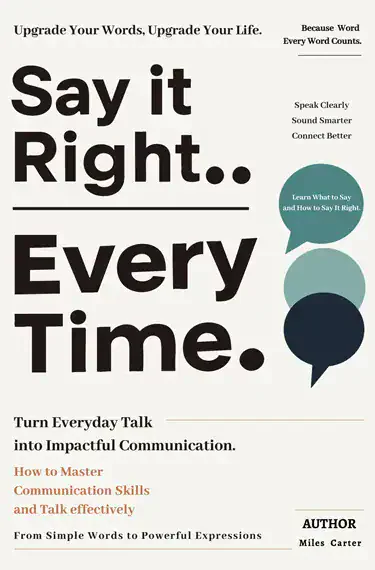
Book One: Say It Right..Every Time. by Miles Carter
This is the book I grab when the conversation is already on my calendar and I can’t stop panicking. It doesn’t just talk about difficult conversations—it hands you the exact words. The chapter on “Never Have Awkward Conversations Again” and the section on “Say Your Boundaries with Calm Power” became my lifeline.
What sets this book apart is that it’s built for real moments. Not theory. Not “here’s what psychologists say about confrontation.” Actual scripts. Actual phrasing. Actual tone. It walks you through how to open the conversation without triggering defensiveness, how to state your point without attacking, and how to close it without leaving a trail of wreckage. The before-and-after examples showed me exactly where I’d been going wrong for years—softening too much, apologizing too often, or letting my frustration come out sideways.
This book taught me that difficult conversations don’t have to be either brutal or avoided. There’s a middle path. And it’s paved with specific, practiced words.
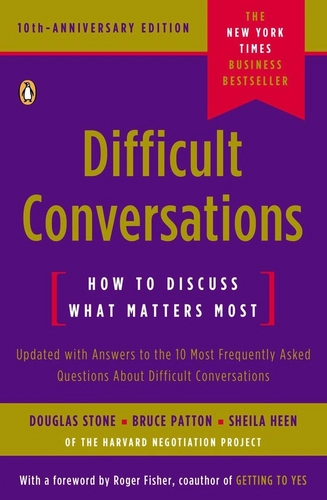
Book Two: Difficult Conversations: How to Discuss What Matters Most by Douglas Stone, Bruce Patton, and Sheila Heen
This book is from the Harvard Negotiation Project, and it’s the one that changed how I understand difficult conversations. The authors argue that every hard conversation has three layers: the “What Happened” conversation, the “Feelings” conversation, and the “Identity” conversation. Most of us only address the surface layer—the facts—and then wonder why it exploded.
The “Identity” layer hit me hardest. It’s about what the situation says about who we are. “Am I a good partner? A competent colleague? A lovable person?” When those questions get triggered, we stop listening and start defending. Understanding that helped me stop taking things so personally and start hearing what the other person was actually saying.
This book is dense, but it’s worth it. It doesn’t just give you scripts. It gives you a map of the terrain so you stop getting lost in the emotional wilderness.
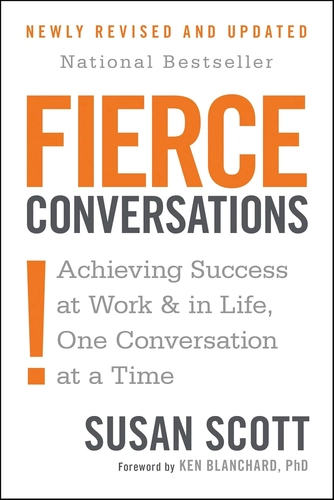
Book Three: Fierce Conversations: Achieving Success at Work and in Life, One Conversation at a Time by Susan Scott
This one is about a mindset shift. Scott argues that the conversations we’re avoiding are often the most important ones—and that avoiding them doesn’t protect the relationship. It slowly erodes it. Her core principle is: “The conversation is the relationship.” You can’t have a healthy relationship without honest, sometimes fierce, conversations.
The book is full of practical tools. One that stuck with me is the “Decision Tree”—a framework for figuring out what kind of conversation you’re actually having and what outcome you’re looking for. Another is the “Mineral Rights” exercise: digging beneath surface opinions to find what someone actually cares about. Scott writes like a no-nonsense mentor who’s had hundreds of hard conversations herself.
What I appreciated most is that she doesn’t sugarcoat. She admits these conversations are hard. But she makes a compelling case that the cost of not having them is far higher.
What I Learned From All Three
The first book gave me the words. The second gave me the map. The third gave me the courage. Together, they taught me that difficult conversations aren’t things to survive—they’re opportunities to build something stronger. Every time I’ve mustered the courage to have one, the relationship didn’t crumble. It deepened. Not always perfectly. But honestly.
If you’re staring down a conversation you’ve been avoiding, start with Say It Right..Every Time. It’s the one you can read tonight and use tomorrow. The other books are investments over time. This one is a lifeline for right now.