
You have said it once. You have said it twice. You have rephrased it, softened it, sharpened it, and tried again with a different tone.
And they still do not listen.
Maybe they nod and change nothing. Maybe they turn it back on you. Maybe they wait for you to finish so they can say what they were going to say anyway. Maybe they are not even pretending to hear you anymore.
If you have been asking yourself how to communicate when someone won’t listen, you are probably not looking for a better script. You are looking for a way out of a conversation that has become a loop.
Why They Are Not Listening
Before you can change how you communicate, it helps to understand why the other person is not receiving it.
They do not want to hear it. Some things are not heard because the listener is unwilling, not because the speaker is unclear. No amount of better wording will change that.
They are defended. When people feel criticized, their first instinct is often to protect themselves rather than to understand. The message gets filtered through their defenses before it ever reaches them.
They have learned that they do not have to listen. If you have repeated yourself many times and nothing changed, they have learned that your words do not require a response. The pattern has told them they can wait you out.
They are not listening to you—they are listening for their turn. Some conversations are not dialogues. They are two monologues happening in the same room.
Understanding this matters because it changes the question. The problem may not be “How do I say it better?” It may be “What do I do when saying it better does not work?”
How to Communicate When Someone Won’t Listen: 4 Shifts That Change Everything
1. Stop Repeating the Same Words
If you have said the same thing three times and nothing has changed, saying it a fourth time will not produce a different result. It will only teach the other person that your words do not need to be taken seriously.
Repetition feels like effort. It is not. It is a way of staying in the conversation without changing the dynamic. The person who repeats themselves is often the person who is afraid to do anything else.
2. Change the Conversation, Not Just the Wording
Instead of trying to say the same thing more clearly, change what you are talking about. Stop discussing the content and start discussing the pattern.
Instead of “I need you to help more,” try “We have had this conversation several times, and nothing has changed. I want to talk about why.”
Instead of “You never listen,” try “I notice that when I bring this up, the conversation goes in circles. I want to understand what is happening.”
This shift moves the conversation from the issue to the dynamic. And the dynamic is usually the real problem.
3. Let Your Silence Do the Work
Many people who do not listen are relying on you to keep the conversation going. As long as you are explaining, arguing, or repeating yourself, they do not have to respond. Your effort fills the silence.
Try not filling it. Say what you need to say once. Then stop. Let the silence sit. Let the discomfort belong to them for a change.
Silence is not withdrawal. It is a statement that you are no longer willing to do all the work.
4. Decide What Happens If They Still Do Not Listen
This is the part most communication advice skips. At some point, you have to decide what you will do if the person never listens. Not as a threat. Not as punishment. But because you cannot spend your life in a conversation that only goes one way.
That decision might be a boundary: “I am not going to keep having this conversation if nothing changes.” It might be distance: “I need to step back from this dynamic.” It might be acceptance: “I cannot make them hear me, and I am going to stop trying.”
None of these are easy. But they are more honest than repeating yourself forever.
When Communication Reaches Its Limit
There is a point where communication stops being the answer. You can say the right words, use the right tone, and follow every communication strategy—and still not be heard. Not because you failed, but because the other person is not available to listen.
In those moments, the question is not “How do I say it better?” The question is “What do I do with the fact that they are not hearing me?”
That is not a communication problem. It is a boundary problem. And boundaries are where communication meets decision.
This is where Say It Right Every Time by Miles Carter can help—not by promising that better wording will make anyone listen, but by giving you the language to respond when they do not.
How Say It Right Every Time Helps When Words Are Not Enough
This is not a book about making people listen. No book can promise that.
It is about something more practical: knowing what to say when the conversation matters, even when the other person is not receptive. It is about the words that keep you clear when you are frustrated, the boundaries that stay intact when someone is dismissive, and the calm that lets you decide what happens next.
The book covers the conversations that are hardest to get right: saying no, asking for what you need, handling conflict, responding to disrespect, and speaking up when it would be easier to stay quiet. It offers practical scripts and side-by-side examples that show how different wording changes the way a message is received—and, just as importantly, how different wording protects you when the message is not received at all.
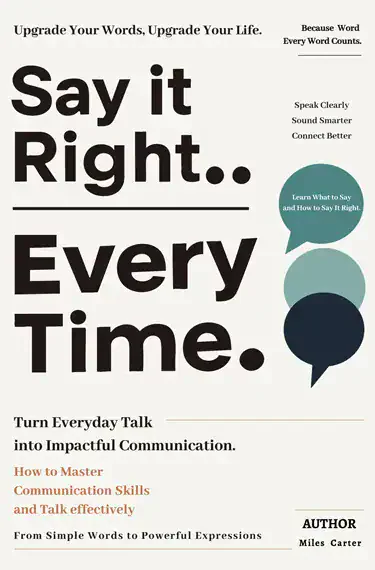
What makes this book different is that it does not treat communication as a magic solution to every relationship problem. It treats it as a skill—one that includes knowing when to speak, when to stop, and when to walk away.
If you have been trying to communicate with someone who will not listen, this book can help you do it once, clearly, and then stop doing all the work.
Final Thoughts: A Summary on How to Communicate When Someone Won’t Listen
Communication is not always about finding the right words. Sometimes it is about recognizing when words are no longer the point.
Stop repeating the same words. Change the conversation from the issue to the pattern. Let your silence do the work. And decide what happens if they still do not listen.
If you are ready to go deeper, Say It Right Every Time by Miles Carter offers practical tools for the conversations that matter—including the ones where the other person is not ready to hear you.
FAQ: Communicating When Someone Won’t Listen
Should I keep trying different ways to say it?
You can try a few approaches. But if you have said it clearly several times and nothing has changed, the problem is not your wording. It is their willingness.
How do I stop repeating myself without giving up?
Giving up and stopping the repetition are not the same thing. You can stop repeating yourself while still holding your boundary. The difference is that you are no longer doing all the work.
What if the person is a boss or family member I cannot avoid?
Then the goal is not to make them listen. It is to protect yourself—through documentation, boundaries, distance, or whatever is available to you.
Is silence the same as giving up?
No. Silence can be a boundary. It sends a clear message that you are not going to keep offering the same words for someone to ignore.