
I found an old message thread last year. Something I had written at twenty three, in a tone I can only describe as aggressively earnest. Three paragraphs of unsolicited advice to someone who had not asked for it. I read it once and felt my whole body fold inward. Then I read it again, which is the real problem, and spent the next hour cataloguing everything wrong with the person who wrote it.
That person was me. She was also, at the time, doing the best she could with what she had. She did not have the information I have now. She did not know what I know now. And I was sitting in the present, with all of that, using it to humiliate her.
That is what cringing at your past self actually is. It is not humility. It is a rigged trial. You are the prosecutor, the judge, and the only witness, and the defendant is not allowed to speak.
Quick Things to Try Today:
- Read the old thing once. Not twice. Once is information. Twice is punishment.
- Ask what the past version of you knew at the time. Not what you know now.
- Give them the context they were operating inside. Age, circumstances, information available.
- Notice when you are using the memory as evidence about who you are today.
- Say one sentence of thanks to them for getting you here. It sounds strange. Try it.
- Put the thing away. You do not need to reread it to prove anything.
The Memory Has Been Edited
The memory you are cringing at is not the event. It is a reconstruction. Every time you revisit it, you edit it. You add the present day awareness. You remove the context that made the behavior make sense. You sharpen the awkward parts and soften the parts where you were actually doing fine.
By the time you have replayed it twenty times, it is not a memory anymore. It is a highlight reel with commentary. And the commentary is written by someone who already knows how the story ends.
This is why the cringe feels so certain. You are comparing an edited past to an idealized present. Of course the past loses. The comparison was never fair.
You Are Judging Someone Who Had Less Information
The version of you who sent the earnest message did not know it would land badly. They did not have the social calibration you have now. They had not yet learned the thing you learned three years later. They were operating with a smaller map.
You would not do this to a friend. If a friend told you they had done something awkward at twenty three, you would not say well, you should have known better. You would say you were twenty three. That is what twenty three is for.
The double standard is the whole problem. You extend context to everyone except the younger version of yourself. And that younger version is the one who actually needs it, because they are the one who cannot defend themselves.
The Cringe Is Usually About the Present
Most of the time, the past self is not the real target. The present self is.
You cringe at the old message because you are afraid of being that person now. You cringe at the old outfit because you are afraid of getting it wrong again. You cringe at the old opinion because you are afraid your current opinions are just as provisional and you cannot see it yet.
The past self becomes a stand in for the fear of being seen as foolish. And since you cannot control how others see you, you practice on yourself. You run the trial in private so that the public one does not catch you off guard.
That is why the cringe does not resolve. You are not actually solving anything about the past. You are managing a fear about the present, and the past is just the available material.
A note if the replay has become a habit:
Occasional cringe is normal. It becomes a problem when the highlight reel runs on a loop, and every old mistake becomes evidence for a verdict you are already carrying. At that point, the issue is not the past. It is the inner voice that keeps using it as a case file.
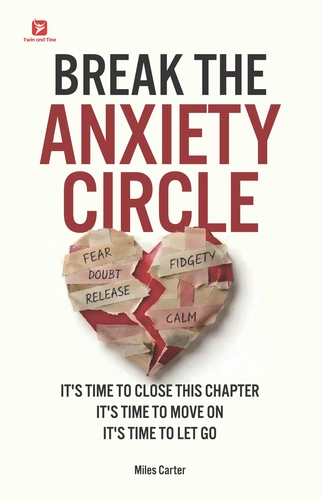
Break the Anxiety Circle by Miles Carter looks at this pattern directly. It is about the loop between overthinking and self-judgment, including why the mind keeps returning to old material, why small moments expand into character assessments, and why action tends to quiet the mind more reliably than analysis does. One section deals with overthinking the past and ruminating on things that cannot change. If you have been running the same memory for years and calling it reflection, this is a useful place to understand what is actually happening.
What Actually Helps
Read it once. Then close it. The first read is information. The second read is a rehearsal. The third read is a habit. Set a limit and keep it.
Ask what they knew at the time. Not what you know now. What information was actually available to that version of you. What they had learned, what they had not. Most cringe collapses when you do this honestly.
Give them the benefit of context. Age, circumstances, the people around them, the culture they were in. You are not excusing the behavior. You are explaining it. Explanation is not permission. It is just accuracy.
Separate the behavior from the person. You did something awkward. That is not the same as being an awkward person. The sentence is not a verdict. It is a sentence.
Notice when the memory is being used as evidence. If you catch yourself thinking this proves something about me, stop. It does not prove anything about who you are now. It proves that you were younger and less informed, which is true of everyone.
Say one thing of thanks. Not out loud if that is too strange. Just internally. Thank that version of you for getting you to this point. They made mistakes and they kept going. That is not embarrassing. That is how you got here.
Replace the reel with a better one. You have a highlight reel of cringe moments. You probably also have a highlight reel of things that went well, things you survived, things you learned. You are not required to only keep the first one.
When the Cringe Is Actually Useful
Not all cringe is punishment. Sometimes it is a signal.
If the memory points to a pattern that is still active, it is useful. You cringe at how you used to talk over people. That is worth noticing, because it might still be happening. You cringe at a boundary you did not set. That is worth noticing, because you might still be avoiding it.
The test is whether the cringe points forward. Useful cringe gives you one behavior change. “I do not do that anymore” or “I should watch for that.” Punishing cringe just repeats. It has no action attached. It is a feeling with no exit.
If the memory keeps returning and you cannot find the lesson, it is probably not about the lesson. It is about the feeling. And the feeling needs a different response than analysis.
When the Past Self Was Actually Wrong
Sometimes the past self did something that genuinely hurt someone. That is not cringe. That is regret. It needs a different response.
Regret calls for repair, if repair is still possible. It calls for acknowledgment, not performance. It calls for a specific change, not a general vow to be better.
Cringe calls for context and release. Regret calls for action. Confusing the two is why some people stay stuck. They treat a real wrong as an embarrassment problem, or they treat an embarrassment as a moral failure.
One Last Thing
I did not delete the old message thread. I thought about it, and then I decided to keep it. Not because I want to reread it. Because it is proof that I was once a person who wrote that, and I am now a person who would not, and that is what growth actually looks like. It does not look like never having been awkward. It looks like having been awkward and then continuing.
The version of me who wrote those three paragraphs was not a fool. She was early. And early is not the same as wrong. It is just the stage before the one you are in now.
References:
- American Psychological Association. Resources on rumination and self-criticism. APA.org.
- Brown, Brené. The Gifts of Imperfection. Hazelden, 2010.
- Harris, R. The Happiness Trap. Trumpeter, 2008.
- Carter, Miles. Break the Anxiety Circle.
FAQ
Q: Why do I cringe at my past self so much?
Because you are comparing an edited memory to an idealized present, and you are using present information to judge someone who did not have it. The comparison is rigged. It is not a fair assessment of who you were.
Q: Is cringing at your past self a sign of growth?
It can be. It means you have changed. But the cringe itself is not the growth. The growth is the change. If the cringe runs on a loop with no lesson attached, it is not growth. It is punishment.
Q: How do I stop the replay?
Read it once. Then close it. Set a limit. When the memory returns, name it and move your attention somewhere else. You are not solving anything by revisiting it. You are just extending the trial.
Q: What if the cringe is about something I actually did wrong?
Then it is regret, not cringe. Repair it if you can. Acknowledge it specifically. Change one thing. Then let it be handled. Regret has an action attached. Cringe does not.
Q: Does everyone feel this way?
Most people do, especially in their twenties and thirties. It tends to soften with age, partly because you accumulate more past selves and stop expecting any of them to have been perfect.
Q: What if I cannot find anything to appreciate about my past self?
Start small. They got you here. They survived things you might not want to think about. They kept going even when they did not know how it would turn out. That is not nothing. That is the whole reason you are here to cringe at them.