I was three sentences into a point when someone started talking over me. Not a quick overlap. A full takeover. He picked up my topic and kept going as if I had handed him the floor.
I stopped. I let him have it. And then I sat there for the next twenty minutes with my face hot and my hands under the table, running the moment on a loop. Not because the point mattered that much. Because I had given away something and I did not know how to get it back.
The freeze is the thing nobody talks about. Not the interruption. The silence after it. The moment where you have to decide, in about half a second, whether to reclaim the floor or let it go. Most people let it go, and then spend the rest of the day wondering why.
Quick Things to Try Today:
- Keep talking. Do not stop. The interruption only works if you yield.
- Raise your hand slightly, palm down. A small gesture that says hold on.
- Use one short phrase. “I am not finished.” Then continue.
- Do not raise your volume. Volume reads as panic. Steady reads as authority.
- If you lose the floor, take it back later. “Going back to what I was saying.”
- Notice the type of interruption. It changes what you do.
Why You Freeze
The freeze is physiological. Under social stress, the language centers get less blood flow. You literally cannot find the words in the moment. This is not weakness. It is the body doing what it does under threat.
There is also a social layer. Many of us were taught that talking over someone is rude, and that reclaiming the floor is also rude. So there is no move that feels allowed. You are stuck between two rules that contradict each other.
And there is the calculation. You weigh the cost of speaking up against the cost of letting it go. The cost of speaking is visible immediately. The cost of silence is invisible, and it accumulates over months.
Not Every Interruption Is the Same
This matters more than any technique. There are at least four kinds of interruption, and they need different responses.
The excited overlap. Someone gets excited and jumps in. It is not hostile. It is enthusiasm with poor timing. Response: keep talking, or let them finish and return. Low stakes.
The habitual interrupter. They do it to everyone. It is a pattern, not a message about you. Response: name it once. “Let me finish this thought.” They usually adjust.
The status move. Someone talks over you specifically, often in front of others, to establish position. Response: reclaim the floor calmly and immediately. Do not let it slide, or it becomes the norm.
The genuine emergency. They have information that changes the conversation. Response: let them speak. This is not disrespect. It is relevance.
The mistake people make is treating every interruption as the status move. Most are not. But if you treat none of them as the status move, that is the one that keeps happening.
What to Say in the Moment
You do not need a speech. You need one short phrase and the willingness to keep going.
“I am not finished.”
“Hold on, let me finish.”
“One second, I am almost there.”
“Let me come back to that.”
The phrase matters less than the follow-through. The follow-through is continuing to talk. If you say “I am not finished” and then stop, you have not reclaimed anything. You have just announced that you wanted to.
The other move is to keep talking without acknowledging the interruption at all. Do not stop. Do not raise your voice. Just continue at the same pace. Most interrupters will stop when they realize you are not yielding. This works more often than people expect.
The Body Does Half the Work
Interruptions are often about momentum, not content. Whoever holds the momentum holds the floor.
So do not stop moving. Keep your posture. Keep your pace. Do not lean back. Do not lower your eyes. The physical signals are read before the words are.
If someone keeps pushing, a small hand gesture helps. Palm down, slightly raised. It is not aggressive. It is a physical version of “one moment.” Most people respond to it without thinking.
Do not raise your volume. Volume reads as panic. Steady reads as authority. The person who speaks slower and quieter often wins the floor, because the room has to lean in to hear them.
A note if the words never come in the moment:
Knowing you should say “I am not finished” and actually saying it while your chest is tight are two different skills. Most people have the intention and lose it in the half second where the decision has to be made.
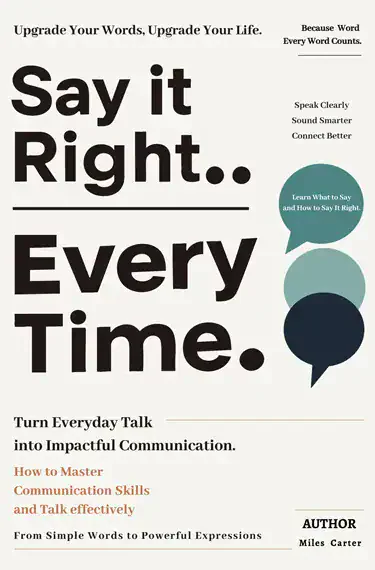
Say It Right Every Time by Miles Carter is built around that gap. It is a practical guide for the conversations that are hardest to handle in real time: being interrupted, handling rude comments, staying grounded when someone pushes, and responding without losing your cool. Instead of general advice, it shows what to say and what often goes wrong, with side by side examples. If you keep replaying conversations wishing you had said something in the moment, this is a useful place to start.
What to Do After You Lose the Floor
Sometimes you will not reclaim it. The moment passes, the conversation moves on, and you are left with the unfinished thought.
You have two options. You can let it go, or you can return to it.
Returning is usually better. “Going back to what I was saying before.” One sentence. No accusation. No reference to being interrupted. Just re-enter the conversation and finish the thought. Most rooms will let you.
This matters because the unfinished thought is what follows you home. Not the interruption itself. The thing you never got to say. Returning closes the loop. Letting it sit keeps it open.
When the Interruption Is a Pattern
If the same person interrupts you repeatedly, the one-off phrase is not enough. You need a different conversation, in a different moment.
After the meeting, or the next day, say one sentence. “I notice you interrupt me in meetings. I would like to finish my points.” Not as an accusation. As information.
Some people genuinely do not notice. They will apologize and adjust. Others will get defensive. That defensiveness tells you something about how much they value your contribution.
If the pattern continues after you have named it, you have options. Speak to them in front of a witness. Raise it with a manager. Or decide that this person is not going to change and adjust your expectations accordingly.
When It Is Not Worth It
Not every interruption deserves a response. Some are careless. Some are excitement. Some are about the other person’s day, not about you.
The test is repetition and direction. A one-off from someone having a chaotic day is not a pattern. A repeated pattern aimed at you is. Save your energy for the second category.
One Last Thing
The next time someone talked over me, I did not stop. I kept going. My voice was flat, my pace was the same, and I finished the sentence. He paused, then let me finish.
Nothing dramatic happened. No confrontation. No apology. The room just adjusted. And I went home without the loop, which was the only real prize.
The freeze is not permanent. It is a habit, and habits can be replaced with one small repetition at a time. The sentence is short. The follow-through is everything.
FAQ
Q: What do I say when someone interrupts me?
“I am not finished” or “hold on, let me finish.” Keep it short, keep your voice level, and keep talking. The follow-through matters more than the phrase.
Q: What if I freeze and say nothing?
That is normal. You can still return to it later. “Going back to what I was saying before.” One sentence, no accusation.
Q: Should I raise my voice to be heard?
No. Volume reads as panic. Speaking slower and steadier usually works better, because the room has to lean in to hear you.
Q: How do I know if it is a pattern or a one-off?
Repetition and direction. A one-off from someone having a chaotic day is not a pattern. The same person interrupting you specifically, repeatedly, is.