
I used to think setting a boundary meant being brave. I would work myself up for days, deliver the boundary in a rush of adrenaline, and then watch it fall apart in the follow-up conversation.
The problem was never courage. I had courage. The problem was phrasing. I would say something like “I need you to respect my time more,” and the other person would hear “you are disrespectful,” and then we would spend twenty minutes arguing about whether they were disrespectful instead of talking about my time.
I learned that a boundary is not a feeling and it is not a complaint. It is a specific statement about what you will and will not do, delivered in language that does not invite a debate about your character or theirs.
Quick Things to Try Today:
- Turn one complaint into a boundary. “You never help” becomes “I need the dishes done by nine.”
- Remove “you always” from your next difficult sentence.
- Say what you will do, not what they must do.
- Practice the sentence out loud once before you need it.
- Prepare one line for pushback. You will need it.
- Keep it under two sentences. Length invites negotiation.
Why Most Boundary Conversations Fail
The conversation usually fails before it starts. Not because the other person refuses. Because the boundary was never actually stated.
There are three common failures.
The complaint. “You never listen.” That is not a boundary. It is an accusation. It invites a defense, not a change.
The wish. “I wish you would think about me more.” That is a hope, not an agreement. It gives the other person nothing specific to respond to.
The ultimatum. “If you do this again, I am done.” That is a threat. It might be true, but delivered this way it triggers fear or anger rather than understanding.
A real boundary is different. It is specific. It is about your behavior, not theirs. And it is stated once, clearly, without a paragraph of justification.

The Structure That Works
There is a shape to a boundary that lands. It is simpler than most communication advice.
When [specific situation], I will [specific action].
That is it. Not what they must do. What you will do.
“When calls run past eight, I will leave the meeting.”
“When you raise your voice, I will pause the conversation and come back later.”
“When I am asked to work weekends, I will say no unless it was planned in advance.”
Notice what these have in common. They are about your actions. They are specific. They do not require the other person to agree with your reasoning. And they are enforceable, because you are the one enforcing them.
There is a second version, useful for closer relationships.
I need [specific thing]. When that does not happen, I feel [feeling]. Here is what I can do about it: [your action].
“I need a heads up when plans change. When that does not happen, I feel anxious. So I am going to confirm plans the morning of, and if I do not hear back, I will make other arrangements.”
That is a boundary with context. Still specific. Still about your action. Still not a demand.
Say What You Will Do, Not What They Must Do
This is the single biggest shift. Most people phrase boundaries as instructions for the other person. Do not do this. Stop doing that. Be more considerate.
Instructions invite negotiation. The other person can argue about whether the instruction is fair, whether they did it, whether you are overreacting. And now you are in a debate about the past instead of a conversation about the future.
Statements about your own behavior are harder to argue with. “I will leave the meeting at eight” is not a claim about their conduct. It is a fact about yours. They can be upset about it. They cannot debate whether you will do it.
This also protects you. If the boundary depends on them changing, you have no control. If it depends on your action, you do.
A note if the words keep coming out wrong:
Knowing what a boundary should sound like is one thing. Producing it in the moment, when the conversation is live and your chest is tight, is another. Most people have the intention and lose it somewhere between the thought and the sentence.
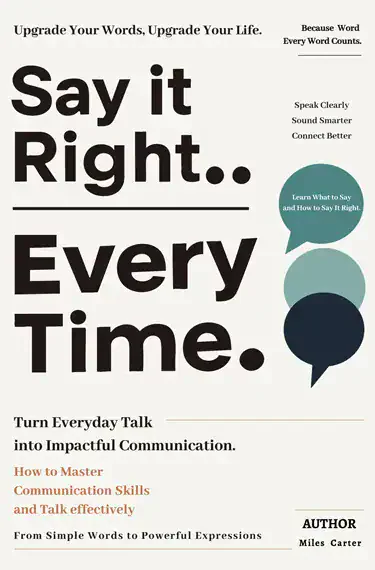
Say It Right Every Time by Miles Carter is built around that gap. It is a practical guide for the conversations that are hardest to phrase: saying no without guilt, making a request that shows respect, disagreeing without creating distance, and setting boundaries with calm power. Instead of general advice, it shows side by side examples of what lands and what backfires. If you keep leaving conversations thinking “that is not how I meant to say it,” this is a useful place to start.
How to Handle Pushback
There will be pushback. Boundaries change an arrangement, and people who benefited from the old arrangement will notice.
The most common pushback is not anger. It is negotiation. They will ask why. They will offer a compromise. They will bring up a time you did the thing you are now declining. They will call you different.
You do not need to defend. You need to repeat.
“I understand. I am still not available on weekends.”
That is the whole move. The broken record. Said calmly, without heat, without a new explanation each time. The first time you say it, it is a boundary. The second time, it is a boundary being held. By the third time, most people stop pushing, because there is nothing to push against.
What you should not do is add new justifications. Each new explanation is a new door for negotiation. Keep the sentence the same. The sameness is the message.
Boundaries Without a Speech
Not every boundary needs a conversation. Some are simply changes in behavior, announced briefly or not announced at all.
You stop replying to messages after nine. You stop lending money. You stop taking on extra work without a clear ask. You do not need to hold a meeting about it. You just do it differently.
If someone notices and asks, you can say one sentence. “I am not doing that anymore.” That is enough. You are allowed to change your behavior without a formal announcement and without a committee approval process.
This is especially useful at work, where long boundary conversations can be read as conflict. A quiet change in behavior is often more effective than a meeting about your limits.
Boundaries With People Who Do Not Hear You
Some people will not accept the boundary no matter how well you phrase it. They will keep pushing, keep negotiating, keep testing.
In those cases, the boundary has done its job. It has told you something about the relationship. Not everyone respects a limit. Some people treat a limit as a personal rejection. That is information.
You do not have to win their agreement. You have to hold the line and let them decide how to respond. If they respond by leaving, they were only there for the version of you that had no limits.
The Follow-Through
The boundary is not the sentence. The boundary is what you do when the sentence is tested.
If you say you will leave the meeting at eight, and then you stay until nine, the boundary was not real. Not because you were weak. Because you taught the other person that the sentence was negotiable.
This is why small boundaries are better than ambitious ones. Start with something you can actually enforce. “I will not answer messages during dinner” is easier to hold than “I will not think about work after six.” Choose the enforceable version.
Why Boundaries Feel Selfish and Are Not
There is a specific guilt that comes with boundaries, especially for people who were taught that being good meant being available.
It helps to reframe what a boundary is for. It is not a punishment. It is not a withdrawal of care. It is the set of conditions under which the relationship can actually continue without resentment.
Resentment is the real relationship killer. Not boundaries. Boundaries are how you prevent resentment from building in the first place. The relationship without boundaries is not more loving. It is just quieter about its cost.
One Last Thing
The sentence I use most is short. “I am not able to do that.” No explanation. No apology. No follow-up paragraph.
The first few times I said it, my hands shook. The other person usually paused, then moved on. Nothing collapsed. The conversation continued. The relationship survived.
The boundary was never the hard part. The hard part was believing I was allowed to have one. And that belief did not come from a book or a speech. It came from saying the sentence and watching the world stay upright.
FAQ
Q: What is the simplest way to state a boundary?
“When [specific situation], I will [specific action].” Say what you will do, not what they must do. Keep it under two sentences and avoid “always” and “never.”
Q: How do I set a boundary without sounding rude?
Short and calm. You do not need to soften a boundary with apologies or long explanations. “I am not able to do that” is polite and complete.
Q: What if the person ignores my boundary?
Hold it without repeating a new explanation. Say the same sentence again. If they keep ignoring it, that is information about the relationship, not a failure on your part.
Q: Why do I feel guilty after setting a boundary?
Because you were probably taught that your needs were an inconvenience. The guilt is a learned response, not evidence that you did something wrong. It fades with repetition.
Q: Can I set boundaries without a big conversation?
Yes. Many boundaries are just changes in behavior, announced briefly or not announced at all. You do not need a formal discussion to stop answering messages after nine.