I asked someone if they were upset with me. They said no. I felt better for about twenty minutes. Then the doubt came back, and I asked again. They said no again. Better for ten minutes. Then I asked a third time, and they looked at me differently. Not angry. Tired.
That was the moment I noticed the pattern. The problem was never the doubt. The problem was the relief. Every time I got the answer, I felt a small drop in tension, and that drop was teaching my brain that the question was necessary. The answer never lasted. The relief did.
Quick Things to Try Today:
Delay one reassurance request by ten minutes. Not forever. Ten minutes.
Name the loop out loud. “This is the asking loop.”
Sit with the unfinished feeling for two minutes before acting on it.
Notice the relief after you obey. That relief is the mechanism.
Reduce one checking behavior today. One search. One text. One question.
Write down what you are afraid would happen if you did not ask.
The Cycle Is Not the Thought
Most people think the cycle is the anxious thought. It is not. The thought is just the trigger. The cycle is what happens next.
A doubt appears. You feel tension. You do something to make the tension stop. The tension drops. For a moment, you are fine. Then the doubt returns, slightly stronger, because the last time you obeyed it, you confirmed it was worth obeying.
That is the loop. Thought, tension, action, relief, repeat. The action is the part that keeps it going. Without the action, the loop cannot close.
Relief Is a Reward
This is the mechanism people miss. Relief is not just the absence of discomfort. It is a reward. It hits the same system in the brain that makes gambling addictive.
You pull the lever, you get a small payout, and your brain learns to pull again. With anxiety, the lever is the check, the reassurance, the avoidance, the search. The payout is the momentary drop in tension.
Every time you get the payout, you strengthen the habit. You are not weakening the anxiety. You are training it.
That is why willpower alone does not work. You are not fighting a thought. You are fighting a reward system that has been running for years.
The Scale of the Loop
Not all loops are the same size. Some are minor and situational. Some are deeply wired.
The Loop
What It Looks Like
What It Costs
Checking
Stove, locks, messages, symptoms
Time, attention, sleep
Reassurance
Asking if they are upset
Relationships, dignity
Research
Searching symptoms or reviews
Hours, more anxiety
Replaying
Rereading messages, conversations
Energy, presence
Avoidance
Cancelling, delaying, hiding
Life shrinking
Perfectionism
Reworking, rewriting, redoing
Completion never happens
Most people have one dominant loop. Find yours. The generic advice will not fit if you are solving the wrong one.
Breaking It Means Not Obeying
The way out is not to think differently. It is to act differently, in small doses, while the anxiety is still present.
You do not need to stop checking forever. You need to check once instead of four times. You do not need to stop seeking reassurance. You need to delay it by ten minutes. You do not need to face your biggest fear today. You need to do one small thing the anxiety told you not to do.
This is not about being brave. It is about being uncooperative with a system that has been running on your compliance.
Start With the Smallest Act of Defiance
Pick one loop. Just one. The stove. The email. The text. The search.
Then do one small version of not obeying.
Check once and leave. Send the message without rereading it. Wait ten minutes before you ask for reassurance. Close the tab. Walk away with the feeling still there.
The feeling will spike. That is expected. It will also come down on its own, without your intervention. That is the lesson your nervous system needs. Not the thought that it will be fine. The experience of it actually being fine.
If the cycle has been part of your life for a long time, it helps to understand the pattern before you try to change it. Not just the surface behavior, but the system underneath. Why you keep checking. Why reassurance never lands. Why the relief is so addictive.
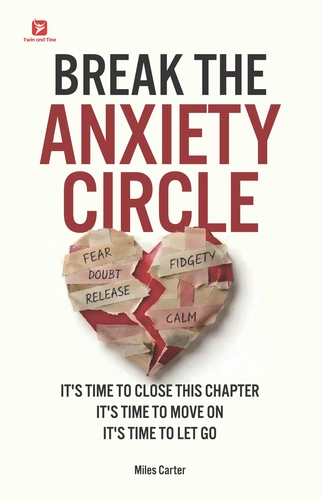
Break the Anxiety Circle by Miles Carter is built around this exact loop. It covers the overthinking, the people-pleasing, and the emotional exhaustion that come from living at the mercy of your own thoughts. There is a chapter specifically on overthinking and peace, one on what to do when thoughts keep you awake, and one on action as the antidote to anxiety. It is not a script for today. It is a map of the pattern.
What to Do When the Anxiety Peaks
Do not run. Do not distract. Do not argue. Just stay.
Sit down. Feel your feet on the floor. Breathe out longer than you breathe in. Notice where the anxiety lives in your body. Chest. Throat. Stomach. Hands.
You are not trying to make it go away. You are trying to prove that you can be with it without obeying it. That is the skill. That is the entire practice.
Peak anxiety lasts a few minutes, not hours. The body cannot sustain it. If you do not feed it with obedience, it burns itself out. If you do feed it, you reset the clock.
When the Loop Is Attached to Something Real
Some anxiety is not irrational. There is a real problem. A health concern. A conflict. A decision. The loop is not the problem. The avoidance is.
In those cases, the fix is not to tolerate the feeling. It is to take the next real step. Make the appointment. Have the conversation. Make the decision. The loop quiets when the item has a plan.
FAQ
Q: How do I break the anxiety cycle when reassurance is the only thing that helps?
Reassurance helps in the moment and feeds the loop in the long run. Start by delaying it. Not eliminating it. Ten minutes. Then twenty. The goal is to teach your system that the feeling is survivable without the answer.
Q: Is avoiding the thing making my anxiety worse?
Yes, usually. Avoidance teaches the brain that the thing is dangerous. Each time you avoid, the danger feels more real. The fix is small exposure, not a leap.
Q: How long does it take to break the cycle?
There is no fixed timeline. The first changes show up in weeks if you practice consistently. Progress looks like a shorter loop, not the absence of anxiety.
Q: What if the anxiety gets worse when I stop the behavior?
It often does, at first. That spike is your nervous system recalibrating. It is not evidence that you should go back. It is evidence that the loop has been running for a while.
Q: Can I break the cycle without therapy?
Many people can, especially if the loop is mild or situational. If the anxiety is severe, long lasting, or tied to trauma, professional support helps.
One Last Thing
I still ask for reassurance sometimes. The habit is old. But I do not ask three times anymore. And the doubt that used to follow me around is quieter than it used to be.
The anxiety did not disappear. The obedience did. And that turned out to be the thing that changed everything.