I was lying in bed at 11:47 PM, staring at the ceiling. My partner was at a work party. He hadn’t texted in three hours.
Nothing bad had happened. I knew that. But my chest was tight anyway. My brain was running laps. What if he’s talking to someone? What if he realizes he’s settling? What if he comes home and tells me it’s over?
I felt the urge to text him. Just a casual “how’s it going?” That’s not controlling, right? But I’d already sent two messages that night. A third one would look desperate.
So I did the next best thing. I opened Instagram and checked if he’d posted anything. Then I checked his friend’s story. Then I checked his location. Then I hated myself for doing all of it.
Does this sound familiar? If you’re here because you keep asking yourself why overthinkers destroy relationships, you already know the answer. You’ve lived it. I have too. Let’s talk about what’s actually happening and what actually helps.
Quick Ways to Stop the Spiral Today
If you feel the urge to check or test, try these:
- Say “This is anxiety, not truth” when the spiral starts.
- Wait 10 minutes before sending that text.
- Put your phone in another room when he’s out.
- Write the scary thought down, then write three calm alternatives.
- Ask for reassurance directly instead of testing.
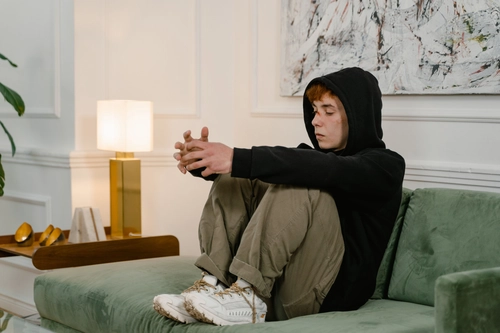
Why Does Overthinking Ruin Good Relationships?
Here’s the part nobody tells you. The overthinking doesn’t start with your partner. It starts with a feeling in your body. Then your brain tries to explain that feeling. And it always picks the worst explanation.
I read something once that stuck with me. Our brains are wired to protect us. When you care deeply about someone, your brain registers that as a vulnerability. So it generates worst-case scenarios to prepare you for the loss. It’s like your mind is trying to build armor against heartbreak. But the armor is made of suspicion and anxiety, and it cuts both ways.
The real damage happens in the small moments. You check his phone. You read into a delayed response. You ask a question that’s really a test. Each time, he feels watched. Each time, he pulls back a little. You sense the pull-back, and it confirms your fears. So you check harder. And he pulls back more.
That’s why overthinkers destroy relationships without meaning to. It’s a slow erosion. Nobody cheats. Nobody lies. But the constant vigilance wears a partner down until they feel like they’re on trial. And eventually, people leave trials.
How Do I Stop Overthinking and Ruining My Relationship?
I wish I could give you a magic phrase that shuts off the spiral. I can’t. What I can give you is a process that worked for me, and for a few friends I’ve talked to about this.
The first step is to name the loop. When I feel that tight chest, I say out loud, “This is anxiety, not truth.” It sounds silly. It helped anyway. Because the thoughts feel 100% real in the moment. Saying that phrase creates a tiny gap between the feeling and the story.
The second step is the “10-Minute Rule.” You can wait 10 minutes before sending that text. Just 10. Then see if you still want to send it. Often, the urge fades. If it doesn’t, send something neutral. Not a question. Not an accusation. Just a small statement like “Hope you’re having fun.” Then put the phone down.
The third step is harder. You have to stop trying to catch him. Every time you check his location or read his message history, you’re training your brain to believe he’s guilty. You’re also training him to feel untrusted. Neither of those things helps.
A Simple Tool That Changed Things for Me
Here’s a tool that changed things for me. When a scary thought appears, I ask four questions:
- Is there actual evidence this is true? Not a feeling. Not a hunch. Evidence.
- If a friend told me this same story, would I tell her to panic?
- What’s the most likely explanation, not the scariest one?
- If this thought is wrong, what am I losing by acting on it?
Question four is the one that got me. Because I realized I wasn’t just losing time to anxiety. I was losing trust. I was losing the easy, comfortable connection we had. I was losing the ability to be present with someone I loved.
Why Overthinkers Destroy Relationships With “Tests”
I had a friend who was convinced her boyfriend was losing interest. So she tested him. She’d go quiet for days to see if he’d chase her. She’d post photos with her friends, hoping to make him jealous. She’d ask questions she already knew the answers to, just to see if he’d slip up.
He never slipped up. But he did get exhausted. And one day, he told her he couldn’t do it anymore. He said it felt like walking on eggshells. She wasn’t trying to hurt him. She was trying to feel safe. But her attempt to feel safe destroyed the very thing she was trying to protect.
I’ve been there too. I remember sending a casual text that was actually a test. “Oh, you’re out with the guys again? Must be nice.” I was fishing for reassurance. He responded with a confused emoji. And I felt worse than before.
Here’s what I learned. Testing someone doesn’t give you information. It gives you anxiety. Because you’re always waiting for the one test that confirms your fear. And when it doesn’t come, you create another test.
The alternative is terrifying. It’s saying out loud, “I’m feeling anxious right now. Can you reassure me?” That feels vulnerable. It feels weak. But it’s honest. And honesty builds intimacy in a way that testing never can.
What If the Fear Is Real?
This is the question that kept me stuck for months. What if my anxiety is actually intuition? What if I’m picking up on something real?
Let me be honest with you. Sometimes the fear is real. Sometimes your partner is pulling away. Sometimes they are hiding something. I can’t tell you that your anxiety is always wrong.
But here’s what I can tell you. The overthinking doesn’t help you handle the truth. It makes you unable to see clearly. Because when you’re in a spiral, you interpret everything through a lens of fear. A normal night out feels like evidence of cheating. A busy day at work feels like emotional distance.
If the fear is real, you’ll find out. You don’t need to investigate every corner of his life to discover the truth. The truth comes out on its own. What you need is enough calm to see it clearly when it does.

Why Overthinkers Destroy Relationships: The Self-Fulfilling Prophecy
There’s a pattern I’ve seen in my own life and in the stories of everyone who’s reached out to me about this. It goes like this:
You feel insecure. You ask for reassurance. Your partner gives it. You feel better for a day. Then the insecurity returns. You ask again. This time, your partner is slightly less patient. You notice the impatience. You panic. You ask harder. Your partner withdraws. You see the withdrawal as proof. You accuse. Your partner gets defensive. The fight escalates. And now there’s real damage.
Nobody cheated. Nobody lied. But the relationship is wounded anyway. That’s why overthinkers destroy relationships. Not because their fears are true, but because their fears become instructions for how to behave.
The way out isn’t to stop caring. It’s to stop letting fear drive the car. You can care deeply and still give your partner space. You can love someone and not know where they are every second of the night.
A Simple Ritual That Helped My Relationship
One thing that actually helped my relationship was creating a ritual. When my partner comes home after being out, we spend time together. No phones. No TV. We just talk about our day. He tells me about the party. I tell him about my evening. We laugh at something silly.
The ritual gives me a concrete moment to reconnect. So I don’t need to check in with him all night. I know there’s a time when we’ll talk. It also gives him space to be himself without feeling monitored.
If you’re in a relationship where this feels impossible, start smaller. Maybe it’s 10 minutes. Maybe it’s just a proper goodbye kiss and a promise to talk later. The point is to create a predictable moment of connection that your anxious brain can rely on.
FAQ
Q: Why do overthinkers destroy relationships even when nothing is wrong?
A: Because the behavior that comes from overthinking creates real problems. Constant checking, testing, and accusations wear a partner down, even if the original fear was unfounded. The relationship dies from exhaustion, not from betrayal.
Q: How do I stop overthinking in a relationship?
A: Start by naming what’s happening. Say “I’m anxious” instead of “He’s cheating.” Then delay your response to the urge. Wait 10 minutes before texting. The urge usually fades. And create a daily reconnection ritual so you don’t need constant reassurance.
Q: Can overthinking ruin a good relationship permanently?
A: It can, if it goes on long enough. But most relationships can recover if both people are willing to change the pattern. The overthinker needs to stop testing. The partner needs to offer consistent reassurance without becoming resentful. It’s hard, but it’s possible.
Q: What’s the difference between intuition and overthinking?
A: Intuition is a calm knowing. Overthinking is a frantic search. Intuition says “something feels off.” Overthinking says “what if, what if, what if.” If you’re panicking, you’re probably overthinking. If you’re calm and certain, it might be intuition.
Q: How do I stop overthinking and ruining my relationship before it’s too late?
A: Have an honest conversation. Tell your partner about your anxiety without blaming them. Ask for what you need, like a goodnight text or a daily check-in. Then commit to not testing them. It’s a daily practice. You’ll mess up sometimes. That’s okay. Just keep going.
One Last Thing
I remember the night I decided to stop checking his location. I sat there with my phone in my hand, thumb hovering over the app. My heart was pounding. It felt like I was letting go of a life raft.
I didn’t check. And nothing bad happened. The next morning, he texted me a photo of the sunrise he saw on his way to work. And I realized, in that moment, that the fear had been lying to me all along. The relationship was fine. I was the one drowning.
You can put the phone down. You can stop the tests. You can choose trust, even when it terrifies you. The fear will still knock sometimes. But you don’t have to let it in.
References
- Levine, A., & Heller, R. (2010). Attached: The New Science of Adult Attachment and How It Can Help You Find—and Keep—Love. TarcherPerigee.
- Gottman, J. M., & Silver, N. (2015). The Seven Principles for Making Marriage Work. Harmony Books.
- Sbarra, D. A., & Hazan, C. (2008). Coregulation, dysregulation, self-regulation: An integrative analysis and empirical agenda for understanding adult attachment, separation, loss, and recovery. Personality and Social Psychology Review, 12(2), 141–167.