You’re lying in bed at 2 AM. Your brain is replaying a conversation from three days ago. Should I have said that differently? Did they take it the wrong way? Why didn’t I speak up?
You try to stop. You tell yourself to just let it go. But the harder you push, the louder the thoughts get.
If this sounds familiar, you’ve probably asked yourself: Can I actually cure this?
Here’s the honest answer: You can’t “cure” overthinking—because it’s not a disease. It’s a habit. A deeply ingrained, often unconscious pattern of protecting yourself by trying to control every possible outcome. And like any habit, it can be rewired.

What is overthinking?
Overthinking is the process of repeatedly analyzing the same thoughts, events, or decisions—without making progress. It’s not problem-solving; it’s rumination. Problem-solving moves you toward a solution. Overthinking keeps you spinning in place.
At its core, overthinking is a misguided attempt at safety. Your brain believes that if you think about something enough, you’ll prevent disaster. But the opposite happens: the more you think, the more anxious you become. You’re not preparing for the future—you’re rehearsing fear.
Can you really stop it?
Short answer: Yes, you can stop it from controlling your life. But not by trying to “turn off” your thoughts.
Here’s what doesn’t work:
- Telling yourself to just stop thinking
- Waiting until you “feel ready” to make a decision
- Avoiding situations that trigger overthinking
Here’s what does work:
- Changing your relationship to your thoughts
- Building new mental habits that replace rumination
- Addressing the deeper fears that drive the loop
You’re not trying to silence your mind—you’re trying to retrain it.
Tip 1: Explore what’s really behind your overthinking
Overthinking is rarely about the surface topic. You’re not agonizing over that email because of the email itself. You’re agonizing because underneath it is a fear: What if I’m not good enough? What if people see I don’t know what I’m doing?
Ask yourself: What am I really afraid of right now?
Common underlying drivers:
- Fear of making the wrong decision
- Fear of being judged or rejected
- Fear of losing control
- Fear that you can’t trust your own judgment
- Perfectionism—the belief that you must get it “exactly right”
If you grew up in an environment where mistakes were heavily criticized, overthinking may have been a survival strategy—a way to avoid punishment by predicting every possible error. Now it’s outlived its usefulness.
When you uncover the real fear, the surface worry loses some of its power.
Tip 2: Be aware of your overthinking warning signs
Overthinking can feel like it comes out of nowhere. But it actually follows a pattern. Learn to recognize your personal early-warning system.
Physical signs:
- Tense shoulders or jaw
- Shallow breathing
- Restlessness—can’t sit still
- Fatigue from mental exhaustion
Mental signs:
- Replaying the same scenario more than twice without new insight
- Asking “what if” questions that have no answer
- Needing constant reassurance from others
- Feeling paralyzed about making decisions
- Noticing that thinking makes you more anxious, not less
When you catch these signs early, you can interrupt the loop before it fully takes hold.
Tip 3: Identify your triggers
Certain situations are more likely to send you into an overthinking spiral. Knowing your triggers helps you prepare—and sometimes avoid unnecessary mental strain.
Common triggers:
- Sending important messages (email, text, work communication)
- Social situations where you feel evaluated
- Periods of uncertainty or transition (new job, moving, relationship changes)
- Late-night hours when there are no distractions
- Receiving feedback—even constructive
- Waiting for replies or decisions from others
Notice your patterns. If late-night overthinking is a trigger, create a “thought cutoff” time—after 10 PM, no more problem-solving. Write it down and deal with it tomorrow.
Tip 4: Cool down quickly when the spiral starts
When you catch yourself spiraling, you need an emergency brake. These techniques can interrupt the loop in seconds.
- Breathe: Inhale for 4 counts, hold for 4, exhale for 6. This triggers your nervous system’s calming response.
- Name it: Say out loud: “I’m overthinking right now. This is my brain trying to protect me, but it’s not helping.” Verbal acknowledgment reduces intensity.
- Write it down: Get the loop out of your head and onto paper. Once it’s externalized, you can look at it more objectively.
- Set a timer: Give yourself 5 minutes to worry—then literally stop when the timer goes off. The act of delaying can break the spell.
- Move your body: Stand up, stretch, walk around. Physical movement interrupts mental loops.
Give yourself a reality check:
Ask:
- Have I gained any new information in the last 10 minutes of thinking?
- Is this thought helping me or hurting me?
- What would I tell a friend who was stuck on this?
- Is there actually a decision to make right now, or am I just rehearsing disaster?
Tip 5: Find healthier ways to respond
Overthinking isn’t a character flaw—it’s a strategy that no longer serves you. Replace it with better ones.
- Shift from “what if” to “what is”: Instead of What if they’re upset with me? ask What do I actually know right now?
- Make “good enough” your goal: Perfectionism fuels overthinking. Practice saying: “This is good enough. I can adjust later if needed.”
- Set decision deadlines: Give yourself a time limit—”I’ll decide this in 15 minutes”—and stick to it.
- Separate planning from worrying: Planning is productive; worrying is not. Ask: “Is this thought leading to action or just more anxiety?”
- Limit reassurance-seeking: Asking others for constant validation feeds the loop. Practice trusting your own judgment.
Recognize passive overthinking:
Sometimes overthinking looks like “researching” excessively, re-reading messages, or endlessly comparing options. These are subtle forms of avoidance. Action is the antidote.
Tip 6: Stay calm by taking care of yourself
Your brain is not separate from your body. When you’re exhausted, hungry, or stressed, overthinking gets worse.
- Prioritize sleep: Fatigue lowers your ability to regulate thoughts. Seven to eight hours makes a visible difference.
- Exercise regularly: Physical activity releases tension and improves mood—making it harder for anxious thoughts to take hold.
- Limit caffeine: Too much caffeine mimics anxiety symptoms and makes your mind race faster.
- Eat steady meals: Blood sugar crashes can trigger irritability and mental fog.
- Schedule genuine rest: Real rest—not scrolling—allows your brain to reset.
Try this simple practice:
At the end of each day, write down one decision you made—big or small—and acknowledge that you made it. Overthinkers often forget they do make decisions daily. This builds evidence that you can trust yourself.

Tip 7: Use humor and perspective
Overthinking takes itself very seriously. Sometimes the best way to break the spell is to lighten up—not dismiss your feelings, but gently question their scale.
When you notice yourself spiraling, try:
- Will this matter in five years?
- Is this the worst thing I’ve ever worried about? How did that previous worry turn out? (Usually fine.)
- If a stranger overheard my thoughts, what would they think?
You can also use self-deprecating humor: “Ah yes, my brain’s favorite hobby—running the same scenario 47 times with no new information.”
Humor doesn’t mean you don’t care. It means you’re not letting fear control the narrative.
Tip 8: Recognize if you need deeper help—and where to turn
If you’ve tried these strategies and overthinking still dominates your life—if it’s affecting your sleep, relationships, or ability to function—it’s worth seeking professional support. Therapy, especially cognitive-behavioral therapy (CBT), is highly effective for breaking rumination patterns.
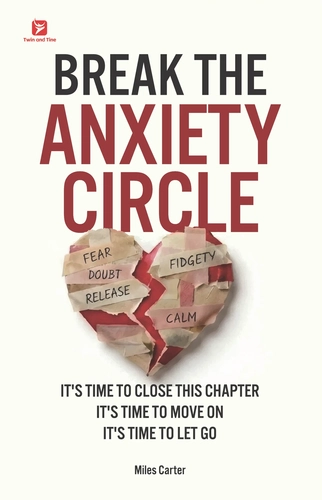
And if you want a structured, self-paced way to rewire the habit—consider Miles Carter’s Break the Anxiety Circle.
This book is written for people exactly like you: exhausted from overthinking, tired of people-pleasing, and ready for a mental reset. It doesn’t offer vague advice. It walks you through:
- Chapter 1: Loving yourself—so you stop searching for worth in others’ opinions
- Chapter 2: Releasing the past—so old regrets stop fueling present fear
- Chapter 3: Taming emotional reactions—so you respond to thoughts with awareness, not panic
As Carter writes:
“Stop searching for your worth in others and start becoming the person who fully supports and believes in yourself.”
That shift is the foundation. When you stop needing external validation to feel safe, the need to overthink every interaction begins to dissolve.
You can’t “cure” overthinking. But you can stop letting it run your life. It’s not about silencing your mind—it’s about changing how you respond to it.
One thought doesn’t have to lead to a spiral. One worry doesn’t have to ruin your day. You can notice the thought, acknowledge it, and let it pass—like a cloud moving across the sky.
That’s not denial. That’s freedom.
Start with one technique today. Just one. And let it remind you: I am not my thoughts. I am the one who hears them—and I get to choose what I do next.