Talking to people is not a skill we are taught. We are taught grammar, vocabulary, how to write essays. But nobody sits you down and explains how to start a conversation with a stranger, how to keep it going when your mind goes blank, or how to end it without making things awkward.
So most of us wing it. We rely on the same handful of questions. We wait for the other person to carry the weight. We panic in silence and fill it with nervous laughter. And then we walk away convinced we are just not naturally good at this.
The truth is that talking to people is a learnable skill. It has patterns, techniques, and specific phrases that work. These three books taught me those patterns. The first one is the one I actually use.
Book One: Say It Right..Every Time. by Miles Carter
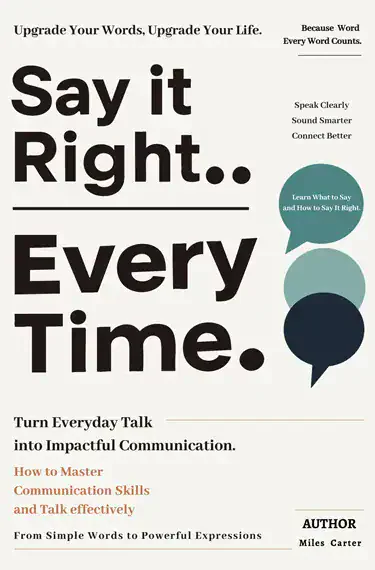
This book is on my desk, not my shelf. Because when I have five minutes before a conversation and I am nervous, I do not need theory. I need words.
The chapter on starting a conversation with anyone gave me an opening line that does not feel fake. The Echo Technique taught me to reflect back what someone says before I respond, which makes people feel understood without any effort. And the section on keeping the conversation going helped me stop panicking when there is a pause. Turns out silence is not failure. It is just space.
What I love is that it covers every situation. Talking to a stranger at a party. Talking to a coworker you do not know well. Talking to someone you are attracted to. Talking to someone who intimidates you. Each chapter gives you actual scripts and before-and-after examples. You see exactly where you were going wrong and exactly what to say instead.
If you have ever stood in a corner at a party pretending to check your phone, this book will change your life.
Book Two: How to Talk to Anyone by Leil Lowndes
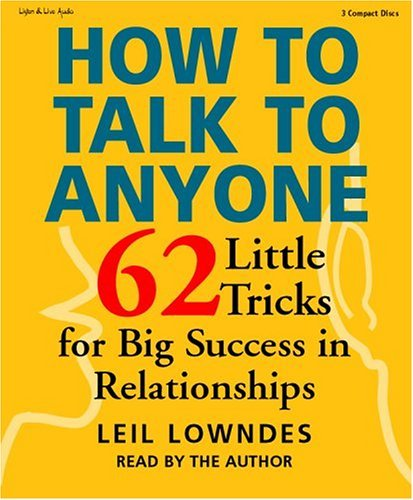
This one is a classic for a reason. Lowndes gives you 92 specific techniques for handling every kind of conversation. Some are small, like matching your tone to the other person’s. Some are bigger, like how to make someone feel like the most interesting person in the room.
The techniques are practical and sometimes surprisingly simple. One that stuck with me is the “sticky eyes” technique, holding eye contact a second longer than feels natural. Another is the “premature we,” using “we” language early in a relationship to create closeness. I was skeptical. Then I tried them. They worked.
The book is a little dated in places, but the core techniques hold up. It is the kind of book you read once and then keep coming back to. If you want a deep toolbox of conversational tricks, this is it.
Book Three: Captivate: The Science of Succeeding with People by Vanessa Van Edwards
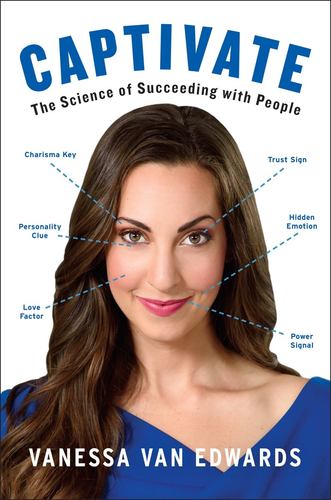
Van Edwards is a behavioral researcher, and this book is about the science behind social interactions. She breaks down everything from handshakes to eye contact to the specific words that make people feel understood.
What I appreciated most is that she does not just tell you what to do. She explains why it works. Why small talk matters. Why certain questions lead to deeper conversations. Why your body language affects not just how others see you, but how you feel about yourself.
The book is full of research and practical exercises. It is dense, but it is worth the effort. If How to Talk to Anyone gives you the tricks, Captivate gives you the understanding behind them.
Why Start With the First One
How to Talk to Anyone gives you a massive toolbox. Captivate gives you the science. Both are valuable. But both are books you need time to absorb and practice.
Say It Right..Every Time. is the one you can use tomorrow. The next time you are about to talk to someone and your mind goes blank, you do not need to remember a research study or a chapter on social psychology. You just need a phrase. A question. A way to start. This book hands you that.
It costs less than lunch. But unlike lunch, you will use it for years.