You don’t lose it at work. You come home and lose it over a dirty spoon. That’s not irony. That’s your nervous system keeping score. Here’s why the same trigger hits differently, and how to stop the spillover, with five real stories from my last year.
Method 1: The “who is this really about?” filter
Last Tuesday, I was on a Zoom with my boss. She interrupted me twice. My chest tightened, but I smiled and kept going. No explosion. No tears. It was fine.
Same day, 6:30 p.m. My partner asked, “Did you take out the recycling?” I snapped: “Do I have to do everything myself?”
Same trigger: being interrupted or asked to do something. Two completely different reactions. Why?
I sat down and wrote out the real difference:
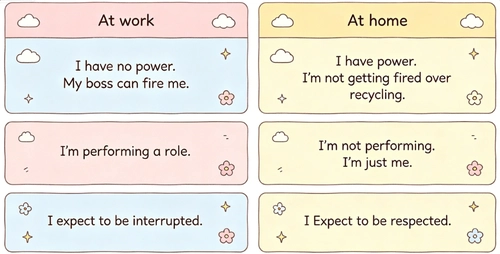
The trigger wasn’t the interruption. It was the unmet expectation. At home, I expected safety. When that got scratched, my system overreacted.
The fix: Before reacting, ask out loud: “Who is this really about?” If the answer isn’t the person in front of you, pause. You’re fighting last week’s battle.
Method 2: Two columns, one conversation
My sister and I have the same trigger: being told “calm down.” It makes us furious.
But she’s a teacher. She gets told “calm down” by 14 year olds all day. She shrugs it off.
I work from home. When my partner says “calm down,” I lose my mind.
So we compared notes. I texted her: “Why can you ignore the kids but not me?”
She wrote back: “Because the kids don’t know me. You do. When you say ‘calm down,’ it feels like you’re saying ‘you’re broken.’ The kids are just being annoying.”
That was the lightbulb. At work, triggers bounce off a professional mask. At home, they hit bare skin.
My rule now: Before I react at home, I ask: “Would I react this way if a stranger said it?” If no, then I’m not angry at the words. I’m angry because I feel seen and dismissed. That’s a different problem, and it needs a conversation, not a fight.
Method 3: A timeline of one trigger, from 9 a.m. to 9 p.m.
Same trigger: someone raising their voice at me.
9:00 a.m. My coworker Dave raises his voice in a meeting. I feel my face get hot, but I take a sip of water and say nothing. The feeling passes in 2 minutes. I forget about it by 10.
12:30 p.m. My husband raises his voice over the phone because the plumber double booked. I hang up, sit on the bathroom floor, and cry for 10 minutes. Then I text him something passive aggressive.
Why the difference? At work, I have a script. “Dave is stressed. It’s not about me.” At home, there is no script. My brain says, “He’s yelling at me,” even when he’s not.
What I learned: Home triggers stick because you have no emotional armor. Work triggers slide off because you’re wearing a costume.
The fix: Visualize putting on a “colleague costume” before you walk in your front door. Not to be fake. Just to remind yourself: this person loves me. But love doesn’t mean they can’t annoy me, and annoyance isn’t an attack.
Method 4: The “ambient load” inventory
Three months ago, I had a full breakdown because my partner left his shoes in the hallway. Ridiculous, right? But here’s what I wrote down afterward.
Home ambient load (things that drain me before any trigger even happens):
- Unwashed dishes in the sink
- The clanking of the radiator at 2 a.m.
- My own to do list on the fridge
- The neighbor’s dog barking
- The mental math of “what’s for dinner”
Work ambient load (things I don’t even notice):
- Slack notifications (I mute them)
- Bad coffee (I expect it)
- A messy inbox (I archive)
- Loud open office (headphones)
The realization: home has way more “background drain” than work. Work is designed to be efficient. Home is designed to be lived in, which means it’s messy, noisy, and full of tiny frictions.
The fix: You can’t remove ambient load, but you can name it. Every evening, I take 30 seconds to list three “low grade annoyances” in my house. Just seeing them on paper cuts their power in half. It’s not the shoes. It’s the 47 things before the shoes.
Method 5: The “work/home crossover” experiment
I wondered: what if I bring a work strategy home?
At work, when I feel triggered, I use a 5 second pause (count to five before speaking). It works most of the time. At home, I never use it because I feel “safe” to snap.
So I forced myself to use the 5 second pause at home for 10 days.
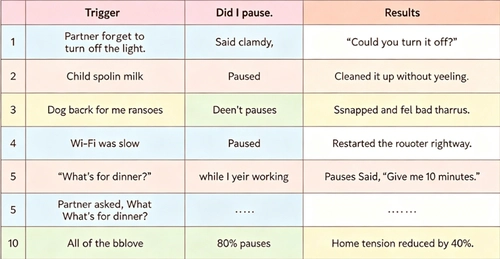
The takeaway: The same tool works at home. You just have to choose to use it. At work, you’re on alert. At home, you relax, and then overreact when something goes wrong. The pause rebuilds the alertness without the anxiety.
The weird bonus section: A single trigger, three different people (and why you’re not broken)
This is not a method. It’s a table I wish I’d seen years ago.
Trigger: “Can you do this faster?”
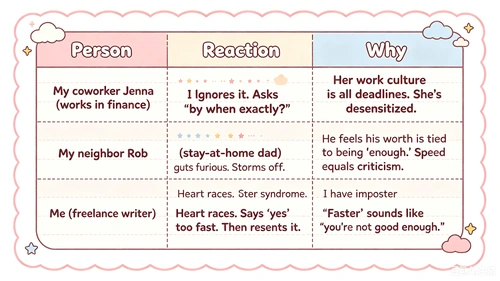
Same words. Three completely different explosions.
Here’s the anti hack: Your reaction isn’t about the trigger. It’s about the story you’ve attached to it. At work, your story might be “I need to prove myself.” At home, the story might be “I need to be loved.”
You can’t remove triggers, but you can find the story. Ask: what would this person have to mean for me to feel this angry? The answer tells you everything.
Quick closing
Work triggers hit your armor. Home triggers hit your skin. It’s the same fire, but different vulnerability. You don’t need to become a robot. You just need different playbooks and permission to pause.