You know the feeling. You open a food delivery app at 11:30 and suddenly it’s 12:10. You scroll through every type of cuisine, read hundreds of reviews, and look at dozens of photos. In the end you just order the same thing as last week. Then you’re not even happy with it, because you’re thinking, “That curry rice looked pretty good though. Maybe next time?” Next time comes and you do the exact same thing again.
Or you’re at a store buying a plain T-shirt. Three colors. Black, white, gray. You stand there for twenty minutes. You pick up black, put it down. Grab white, hang it back. A little voice says, “Black goes with everything but it’s hot. White looks clean but it stains. Gray is just… nothing.” You walk out empty-handed and think, “Fine, I’ll just buy it online.” Then you fall into an even deeper ocean of reviews.

I used to be way worse than this. I would compare the price per square foot of toilet paper. When I was switching jobs, I spent a whole month making an Excel spreadsheet with four pages of pros and cons, and in the end I just picked the first option. I might as well have done nothing. This kind of decision paralysis isn’t laziness. It’s the fear of picking the wrong thing, the feeling that there’s one “perfect” choice out there, and if you mess it up, you’re doomed. That mindset drains your energy. The time you spend agonizing is worth way more than whatever tiny difference there is between your options.
Eventually I got sick of myself and started figuring out how to stop. These five tricks helped me turn “what do I pick” from a huge mental burden into something that barely takes any energy.
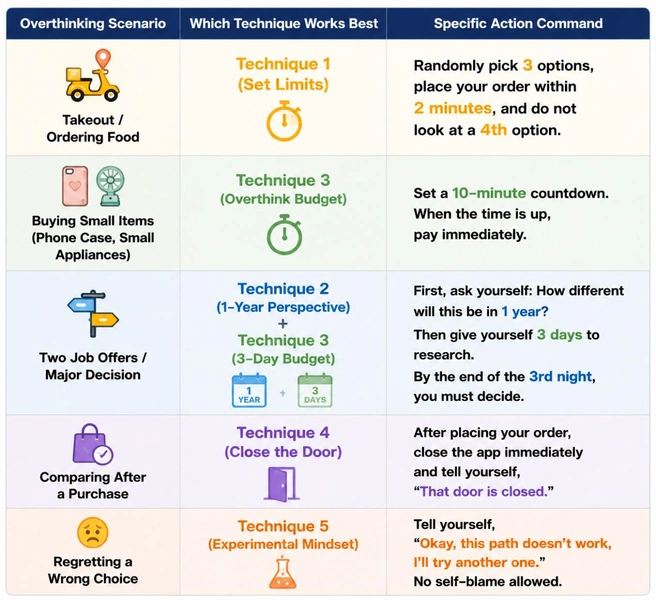
Trick one: Cap your options at three and toss one out if you have more.
I used to think more options meant a better chance of finding the perfect answer. All it gave me was information overload and a frozen brain. So I made a hard rule: for any everyday decision, I only look at three options. What’s for lunch? Pick three random restaurants, choose one, no scrolling to a fourth. Buying a gadget? Pick three models at similar prices, compare them, make a call, and don’t click “you might also like.”
It sounds childish, but here’s the truth: the real difference between most options is tiny, and the time you waste on agonizing is way bigger than that tiny difference. The first time I tried this, I picked three places: spicy soup, a deli sandwich, and pho. I chose pho in under two minutes. Honestly it wasn’t amazing when I ate it. But I realized I didn’t feel the usual regret, because I knew I made a decision based on a rule, not after half an hour of torture in endless choice hell. That day, I finally understood what “good enough” really means.
Trick two: Ask yourself, “Will this choice matter a year from now?”
Most of the stuff we obsess over looks completely different when you zoom out. I used to spend half an hour picking a phone case. Then I forced myself to stop and ask: a year from now, am I going to remember what color I picked today? Obviously not. So just pick one.
This works for bigger stuff too. I once had two job offers and agonized for two weeks, comparing salary, commute, team vibe, growth potential. Then I asked myself: looking back five years from now, is the difference between these two options about “right versus wrong” or just “two different paths”? I thought about it for a while and realized both were good. Neither was a dead end. So I let go, picked one, and went all in. Later I saw that my choice wasn’t perfect. But no choice ever is. What matters isn’t what you pick. It’s what you do after you pick it.
Trick three: Set a “decision budget.”
I used to take forever because I thought thinking a little longer would make things clearer. Then I realized no amount of thinking can beat the fact that reality changes. So I started giving every decision a time limit. I call it my “decision budget.” For a small thing like a twenty-dollar kitchen gadget, my budget is ten minutes. In that ten minutes I gather key info, read a few reviews, compare two or three models. When time’s up, I buy it, even if I’m not totally sure. For bigger things, like signing up for a class that costs a few hundred dollars, my budget is three days. I let myself research, ask people, list pros and cons. But on the third night, I decide and I don’t look back.
What’s great about this is it forces you to accept a fact: you will never have one hundred percent of the information. You can never explore every possibility. Stopping when time is up is how you respect your own energy. The most honest thing I learned is that the decisions I made after two days of agonizing turned out about as good as the ones I made in twenty minutes. The extra time was just me feeding my own anxiety.
Trick four: Once you’ve picked, don’t open the other door.
People with decision paralysis have one thing in common. They can’t let go after they decide. They can’t stop peeking at the road not taken. I buy a pair of headphones, model A. Then I secretly go read reviews for model B. Someone raves about the sound quality on B, and suddenly I feel sick, like I messed up. What do you call that? Self-torture.
So I made an iron rule. After I decide, I cut off all comparison channels. I hit buy and close the shopping app. No more reading “similar products.” I take a job and stop looking at other job postings. I pick a restaurant and stop checking reviews for the other one. I even tell myself out loud, “That door is closed. Whatever’s behind it is none of my business now.”
This habit is hard at first, because curiosity keeps tugging at you. But after a few times you realize something. Not knowing how good B is actually makes you feel better, because your only frame of reference becomes “is what I picked actually any good?” instead of “did I pick the absolute best?” The first one lets you improve and enjoy. The second one just makes you miserable.
Trick five: Replace “if I pick wrong I’m dead” with “picking wrong is just data.”
At the bottom of all this is fear. You’re scared of picking wrong because you’ve blown up the consequences a hundred times in your head. You buy the wrong face lotion? At most you wasted twenty bucks. But your brain spins it into “my skin will melt off and I’ll hide from the world.” You order a bad lunch? It’s one disappointing meal. But you tell yourself you can’t even handle something as small as lunch.
To beat this fear, I started looking at every choice as an experiment, not an exam. An experiment means you pick A over B simply because it seems like the better bet right now. If it turns out wrong, you just got one piece of data: A didn’t work. Now you’re smarter for next time. Scientists don’t call that “failure.” They call it “eliminating an incorrect hypothesis.”
Now every time I buy something that doesn’t work out or make a decision that wasn’t great, I say to myself, “Alright, got it. That one didn’t work. Next time I’ll try something else.” No guilt trip. No endless replay. Just one piece of data. Shifting from a fixed mindset to a growth mindset is really just this step: going from “I picked wrong, so I’m stupid” to “I picked wrong, so now I know one more way that doesn’t work.”
I’ll be honest with you. I still get stuck sometimes. Last week I was buying a chair and spent three minutes going back and forth between two colors. The difference is, after three minutes I told myself “okay, time’s up,” and I grabbed the dark gray one. When it arrived I noticed the gray looked slightly green under my lights. Not a perfect choice by any means. But I thought, “So it’s a little green. It’s comfortable.” The old me would have stayed inside that greenish shadow for days.
So look, stopping decision paralysis isn’t about turning into some robot who never hesitates and never regrets. It’s about taking back the time and energy you’ve been burning on stuff that genuinely does not matter, and spending it on things that do. Like actually enjoying that meal. Actually using the thing you spent half an hour picking. Actually living your life after you’ve made the call.
Next time you’re frozen in front of a shelf, just try one of these five tricks. Just one. You don’t have to become a decisive person overnight. All you need to do is obsess for five minutes less than you did last time. That’s enough.
Here’s a cheat sheet. Next time you freeze on lunch, a gadget, a job, or post-purchase regret, find your situation below. It tells you which trick to use and exactly what to do. No thinking. Just follow the move.