I once sat through a forty minute meeting with a concern that would have changed the decision. I had it fully formed in my head. I knew exactly what I wanted to say. I rehearsed it three times. And when the moment came, I said nothing. The decision was made. The problem showed up two weeks later, exactly as I had predicted. And nobody knew I had seen it coming.
The worst part was not the outcome. It was the silence. I had the information. I had the timing. I had a legitimate concern. And I let the moment pass because my chest was tight and I was waiting for a confidence that never arrived.
That is what speaking up at work actually is. It is not a personality trait. It is a decision made in a moment when your body is telling you to stay quiet.
Quick Things to Try Today:
Write one sentence before the meeting. One position, one question, one concern.
Speak early. The first three minutes are easier than the last three.
Ask one question out loud today, even a small one.
Stop prefacing. Remove “just,” “sort of,” “sorry to interrupt.”
Say one thing in a meeting and let it be enough.
Notice the silence after you speak. It is shorter than it feels.
Write down what you wished you had said. Do it for a week. Patterns will appear.
Why Speaking Up Feels So Hard
The fear is not irrational. Speaking up carries real risk. You can be wrong. You can be dismissed. You can be interrupted. You can draw attention to yourself in a room where attention is not always safe. The nervous system does not distinguish between social risk and physical risk. It responds the same way. Heart rate up, voice tight, mind blank.
There is also the history. If you grew up in a house where talking back had consequences, or in a school where being wrong was humiliating, or in a previous job where speaking up got you punished, your body learned that silence was safer. That learning does not disappear because you are now an adult in a meeting room.
Then there is the waiting problem. Most people wait to feel ready. They want to be certain, calm, and confident before they speak. That readiness rarely arrives. So they stay quiet, and the quiet reinforces the idea that speaking is dangerous.
The Reframe That Changes the Stakes
Speaking up at work is not a performance. It is a contribution. That distinction matters more than it sounds.
When you treat it as a performance, the question becomes how did I do. Did I sound smart. Did I say it right. Did people respect me. Every answer is uncertain, and the uncertainty keeps you quiet.
When you treat it as a contribution, the question becomes did I add something useful. That question is answerable. You either gave information the room did not have, or you did not. You either asked a question that needed asking, or you did not. The focus moves off you and onto the work. That shift reduces the fear, because the fear was never about the work. It was about being judged.
What Actually Helps Before the Meeting
Prepare one sentence, not a script. Scripts collapse under pressure. One clear sentence holds. A position, a question, a concern. “I think we should delay the launch a week.” “What is the rollback plan.” “I have a concern about the timeline.” That is enough to start. The rest will follow.
Decide where you will speak. Read the agenda. Pick the moment where your input belongs. Having a specific slot reduces the panic of finding the right opening. You already know where you are going.
Sit where you can be seen. Not in the back corner. Not behind the tallest person. Proximity to the conversation matters. When you are visible, speaking feels more natural because you are already part of the room.
Ground your body before you speak. Put both feet on the floor. Slow your exhale. Drop your shoulders. You are not trying to feel calm. You are trying to feel present. The body settles faster than the mind.
What Actually Helps During the Meeting
Speak early. The first contribution is the hardest. Every minute you wait makes it harder, not easier. Say something in the first five minutes if you can. Even a small question. Once you have spoken once, the second time is easier. The silence barrier is broken.
Stop prefacing. Remove the small words that shrink your point. “I just wanted to mention,” “I am not sure but,” “this might be stupid but,” “sorry to interrupt.” These phrases tell the room that what follows is optional. Say the thing without the apology.
Slow down. Fear speeds people up. Rushing makes you sound less certain than you are. Pause between sentences. Let the silence exist. Slowing down signals confidence to your own nervous system and to the room.
Do not over-explain. Make your point. Let it land. If someone has a question, answer it. If not, stop. The urge to fill the silence after your point is usually fear, not communication.
Use “I” statements when it is your view. “I think,” “I noticed,” “my concern is.” This is not weakness. It is accuracy. It is your view, and you are allowed to state it.
Handle being interrupted. It will happen. The trick is not to get louder. It is to continue. “I am not finished.” Said calmly, without heat. Most people will pause. If they do not, repeat it. You do not need a speech. One sentence is enough.
What to Do After You Speak
Let the silence be. There will be a pause after you speak. It will feel much longer to you than to everyone else. Do not fill it. Do not backtrack. Do not add a caveat. Sit with it. The pause is normal. It happens to everyone.
Notice what actually happened. Did the room collapse. Did anyone mock you. Did the meeting end because of your question. The evidence matters. Your nervous system needs proof that speaking is survivable. The proof comes from experience, not from theory.
Repair if you need to. If you said something badly, you can return to it. “Let me try that again. What I meant was.” Repair is not weakness. It is skill. Most people never notice a small correction.
Do it again sooner. The second time is easier than the first. The tenth is easier than the second. Exposure works. Avoidance makes everything worse. If you speak once and then stay silent for a month, you lose the momentum.
When the Room Is Not Safe
Not every workplace rewards speaking up. Some rooms punish it. Some managers take questions as challenges. Some teams are built on unspoken hierarchy. In those environments, the risk is real, and the advice to speak up can be dangerous.
The first step is to read the room. Is speaking up actually safe. Have you seen others do it and survive. Is there a manager or colleague who can support you. If the answer is no, the goal is not to be brave in an unsafe room. The goal is to document, to build options, and to find a safer place to speak.
You are not obligated to be brave in a room designed to punish it. That is not confidence. That is self preservation.
Sometimes the problem is not courage. It is phrasing. You finally speak up, and it lands harsher than you meant, or softer than you needed, or in a way that starts a conflict you did not want. The intention was right. The wording was off.
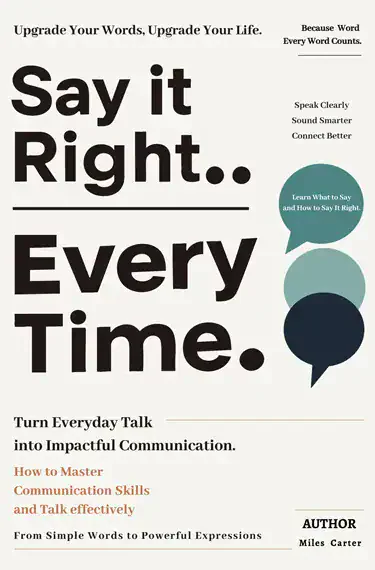
Say It Right Every Time by Miles Carter is built for exactly that gap. It is a practical communication guide for the conversations that are hardest to get right: saying no, asking for what you need, handling conflict, expressing feelings, and speaking up at work. Instead of vague advice like “be more confident,” it shows you how different wording changes the way a message is received, with side by side examples and scripts for real situations. There is a section on saying no without guilt, one on disagreeing without creating distance, and one on staying grounded when someone is rude. If you keep leaving conversations thinking “that is not what I meant,” this is a useful place to start.
One Last Thing
I still get nervous before meetings. The chest tightens. The voice wants to go quiet. But I have learned to speak before the fear finishes its argument. One sentence. Then another. The room does not collapse. The decision improves. And I go home with less of that specific weight, the one that comes from knowing something and staying silent.
The confidence did not come first. The speaking came first, and the confidence followed. That is the order. It always was.
FAQ
Q: Why do I go blank when I try to speak in meetings?
Your working memory is being used up by self monitoring. Preparation helps. One sentence ready reduces the panic of the blank mind.
Q: How do I stop being afraid of speaking up?
You probably will not stop. The goal is to speak anyway. Fear can be present while you talk.
Q: What if I say something wrong?
You probably will at some point. You can always return to it. “Let me correct that.” Most people forget small corrections within minutes.
Q: Should I speak up if I am the most junior person in the room?
Yes, if the room is safe. Being junior does not mean being wrong. You often have information the senior people do not have.
Q: How do I handle it when someone talks over me?
Continue speaking. “I am not finished.” Calmly, once. If they do not stop, repeat it. If the room still does not respond, you have learned something about the room.