What if you treated your self-critical thoughts as just noise, not wisdom?
Most advice says “be kinder to yourself.” That feels vague and hard to do. Here is a different assumption: your inner critic is not a helpful editor. It is just a habit of repeating the same negative sentences. Last month, I spent 40 minutes replaying a two-second awkward pause in a conversation. That is when I realized the critic does not protect me. It just repeats. Below is the method I built from that afternoon. Four moves. Four formats. No metaphors.
1. 【Role-play script】Give the critic a boring name
You cannot argue with a voice you treat as truth. Separate the voice by giving it a neutral, boring label.
Write this on a sticky note:
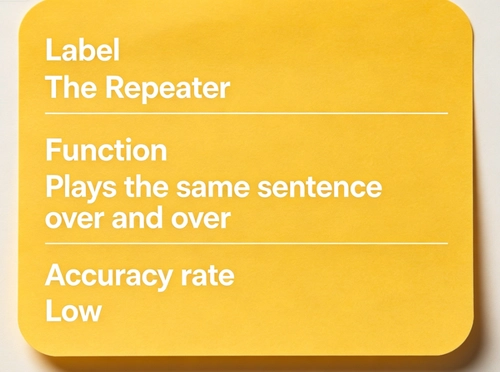
Next time you hear “You messed up again,” do this:
Step A. Say out loud: “That is just The Repeater.”
Step B. Do not argue. Just acknowledge.
Step C. Ask: “Is there any new information in this sentence?” (The answer is almost always no.)
Real experience: Before a team call last week, my brain said “You are going to sound stupid.” I labeled it “Repeater,” realized it had said the same thing before every call for two years, and took a steady breath. The call was fine.
2. 【Scoring card】The “real damage” check
Your critic lies by making small things feel huge. Use two questions to check the actual size of the problem.
Draw a simple table on scratch paper:
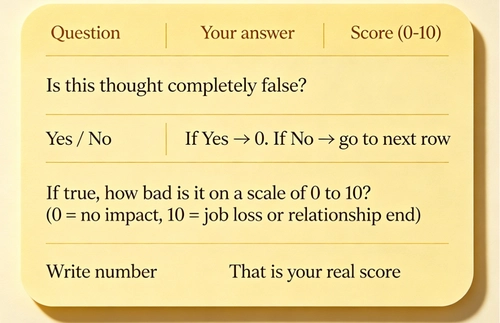
My log from last Friday:
Thought: “I sounded awkward in that meeting.” → Not completely false (I did pause once) → Severity score: 2 out of 10.
Thought: “Everyone noticed and lost respect for me.” → Completely false → Score 0.
Add the scores. If the total is under 5, the critic is making noise about nothing. If over 5, you have a real problem to solve. Go solve it; do not replay it.
I timed this. It took 90 seconds. You do not need to argue. You just need to check the numbers.
3. 【Rewrite exercise】Change “I” to your name, then add “sometimes”
Your critic uses dramatic words like “always” and “never.” Force it to be boring.
Step one: Write the exact critical sentence.
Example: “I cannot believe I forgot that name. I am so stupid.”
Step two: Change “I” to your name.
Example: “Alex cannot believe Alex forgot that name. Alex is so stupid.”
Step three: Replace the dramatic word (“stupid”) with “a person who sometimes forgets things.”
Example: “Alex is a person who sometimes forgets things.”
Step four: Read it out loud.
Real experiment: I did this after forgetting a colleague’s spouse’s name. Original: “I am so rude and thoughtless.” Rewrite: “Chris is a person who had a normal memory lapse.” I read it and felt the shame drop by about 80 percent.
4. 【Time test】The “one-week rule”
Your critic acts like every mistake lasts forever. Test that assumption with a calendar.
Ask three questions. Write the answers.
Question 1: Will this matter tomorrow? (Yes / No)
Question 2: Will this matter in one week? (Yes / No)
Question 3: Will this matter in one month? (Yes / No)
If you answered No to Question 2 or 3, you can drop it now.
Real example: Last week I mispronounced a client’s name. Question 1: it was maybe a little awkward. Question 2: No. Question 3: No. I dropped it. The call finished fine. The client did not mention it.
5. 【30-second ritual】When you have no time
Point at your ear (as if listening to the critic).
Say “Noted.” (Not “You are right.” Not “Be quiet.” Just “Noted.”)
Snap your fingers once. That snap closes the note.
Take one breath. Then do the next small action (drink water, type one letter, stand up).
I have used this in the middle of meetings. No one notices. But the critic stops. Because a critic only continues when you argue with it. “Noted” is not an argument. It is a closure.
Final truth: Your inner critic is not trying to help you. It is a mental habit of repeating old sentences. The fastest way to reduce its power is not to fight it. It is to treat it as boring noise. Give it a neutral label. Check the real damage. Rewrite its sentences. Test the timeline. Then get on with your day.
One sentence to remember: You do not need to silence your inner critic. You just need to stop treating its sentences as facts.