Daytime anxiety has somewhere to go. You can clean the kitchen, answer emails, run an errand, call a friend. The nervous energy gets absorbed by motion. Night is different. Night strips all of that away. The distractions disappear, the house goes quiet, and suddenly there is nothing between you and your own mind.
That is not a coincidence. It is biology and psychology working together. Cortisol patterns shift. Fatigue lowers your emotional resilience, so the same thought that rolled off your back at noon now feels like a crisis. And with no external input to anchor you, your brain turns inward and starts searching for problems to solve. It finds them, because it always does.
So if you lie awake at 2 a.m. with your heart pounding over something that will seem manageable in the morning, you are not broken. You are experiencing a predictable collision between tiredness, silence, and a mind that never learned how to stand down. The three books below helped me understand that mechanism and, more importantly, gave me something to do about it.
Book One: Break the Anxiety Circle by Miles Carter
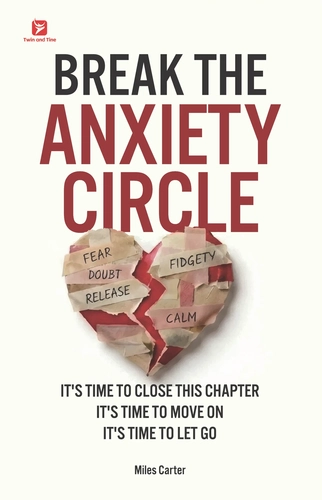
This book explained nighttime anxiety better than anything else I have read. It has a chapter called “What If Thoughts Keep You Awake At Night?” and another called “Overthinking Will Kill Your Peace,” and both felt like they had been written by someone who had actually lain there at 3 a.m. watching the ceiling.
The core insight is that night anxiety is a feedback loop with nothing to interrupt it. A thought triggers fear. Fear triggers a physical response. The physical response confirms the thought. During the day, a phone call or a task breaks the circuit. At night, there is nothing, so the loop just runs. The book does not tell you to relax or empty your mind. It gives you specific, small actions that interrupt the spiral even when you are exhausted and your thoughts are racing.
What I appreciated most is that it addresses the shame. That voice that says you should be able to sleep, that other people do not have this problem, that something is fundamentally wrong with you. The book helps you set that judgment down so you can actually work with your mind instead of fighting it at the worst possible hour. This is the one I keep on my nightstand, not my shelf.
Book Two: Why We Sleep: Unlocking the Power of Sleep and Dreams by Matthew Walker
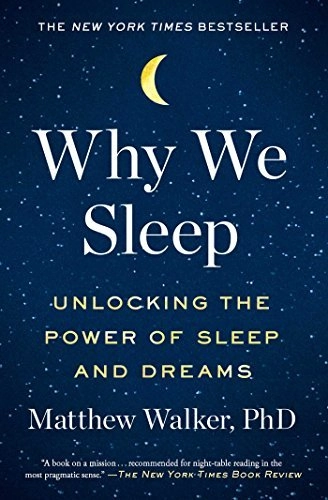
Walker is a neuroscientist, and this book explains the machinery behind what you experience at night. It covers how sleep pressure builds, how the brain cycles through stages, and why anxiety and insomnia feed each other in a loop that gets worse the more you try to force sleep.
The most useful part for me was understanding that lying in bed awake and trying harder is one of the worst things you can do. The brain learns to associate the bed with frustration, which makes the next night worse. Walker also explains why fatigue amplifies emotional reactivity, which is why a worry that seems trivial at noon can feel catastrophic at midnight.
This book is dense in places, and it covers far more than anxiety. But if you have ever wondered why your mind turns on you specifically after dark, it gives you the biological answer.
Book Three: Say Good Night to Insomnia by Gregg D. Jacobs
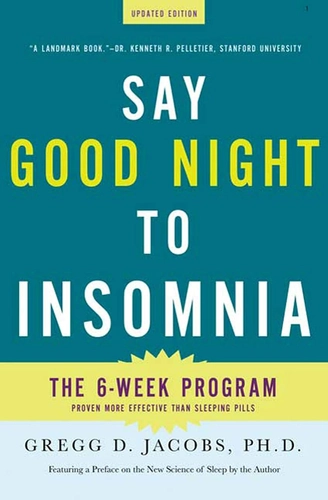
Jacobs developed one of the most researched non-drug treatments for insomnia, and this book is the practical version of that program. It is built on cognitive behavioral therapy for insomnia, which means it does not just explain the problem. It gives you a structured plan to fix it.
The central idea is that insomnia is maintained by the things you do to cope with it. Going to bed early. Napping. Lying there hoping. Checking the clock. Each of these feels reasonable and each one makes the problem worse. Jacobs walks you through how to rebuild your relationship with sleep, including how to handle the anxious thoughts that show up the moment the lights go out.
What I valued most is that it treats nighttime anxiety as a learned pattern rather than a permanent condition. Patterns can be unlearned. It takes consistency, but it works.
If You Are Reading This at 3 A.M.
The other two books are worth your time. Why We Sleep will explain the science. Say Good Night to Insomnia will give you a structured program. But both are books you read during the day, when your mind is clear enough to absorb them.
Break the Anxiety Circle is the one you can open tonight. It is written for the exact moment you are in, when your chest is tight and your thoughts are loud and reading a neuroscience chapter is simply not going to happen. The techniques are short enough to remember and simple enough to use while you are lying in the dark. That is a rare thing in a book about anxiety, and it is why this one stays within arm’s reach.