Most emotional regulation advice is useless. It tells you to take a deep breath, count to ten, or think positive thoughts. That is not a technique. That is a platitude. When your chest is tight and your thoughts are spiraling and every cell in your body wants to scream or run or shut down, counting to ten does nothing. The emotion is already in the driver’s seat, and no amount of deep breathing is going to wrestle the wheel away.
Real emotional regulation is not about controlling what you feel. It is about what happens in the gap between the trigger and your response. That gap is tiny, often less than a second, but it is where everything that matters lives. Whether you snap at your partner or stay calm. Whether you send the angry email or close the laptop. Whether you spiral into shame or treat yourself with compassion. The books below taught me how to widen that gap. Not by fighting my emotions, but by understanding them well enough to choose what comes next.
Book One: Break the Anxiety Circle by Miles Carter
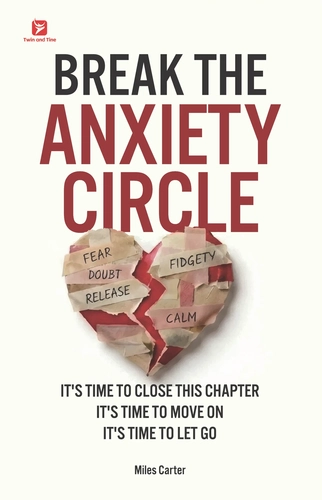
This book reframed emotional regulation for me completely. It does not treat emotions as problems to be solved or suppressed. It treats them as signals. The chapter on emotional reactivity explains that most of what we call “losing control” is actually a feedback loop. A feeling triggers a thought. The thought triggers a physical response. The physical response confirms the feeling. By the time you notice what is happening, you are already deep inside the spiral.
What makes this book different is that it gives you techniques that work in that moment. Not theory. Not something you need to practice for months before it helps. Small, physical actions that interrupt the loop before it completes itself. The chapter on staying grounded when someone is rude gave me a script I have used more times than I can count. The section on responding without losing your cool taught me that the pause between stimulus and response is a muscle. You build it by using it.
I keep this book within reach at all times. When I feel myself tipping into reaction, it is the first thing I grab. Because it does not ask me to be calm before I start. It meets me in the chaos.
Book Two: Permission to Feel by Marc Brackett
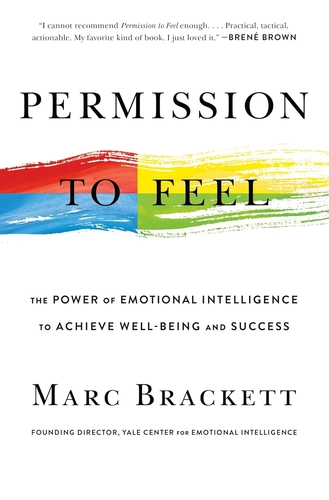
Brackett runs the Yale Center for Emotional Intelligence, and his book is built on a simple but profound idea: you cannot regulate an emotion you cannot name. Most of us are emotionally illiterate. We know happy, sad, angry, scared. But we cannot distinguish between disappointment and shame, between anxiety and dread, between irritation and resentment. And that vagueness makes regulation impossible.
He introduces the RULER framework: Recognizing, Understanding, Labeling, Expressing, and Regulating emotions. The labeling part changed everything for me. When I started naming what I was actually feeling instead of defaulting to “stressed” or “fine,” the intensity dropped. Naming an emotion forces your brain to move from the reactive amygdala to the thinking prefrontal cortex. That shift alone creates the gap you need.
This book is warm, practical, and backed by decades of research. It gave me a vocabulary for my inner life. That vocabulary became the foundation for every other regulation technique I have learned.
Book Three: Emotional Agility by Susan David
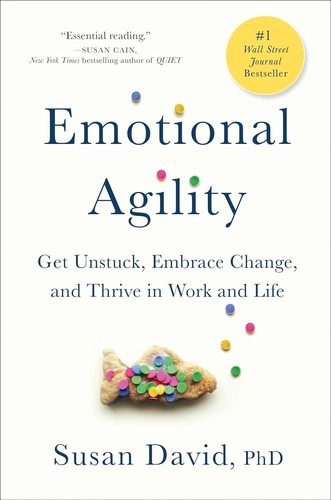
David is a psychologist at Harvard, and her core argument is that the way we handle our emotions determines everything. She does not teach suppression. She does not teach positive thinking. She teaches something harder and more honest: you can feel a difficult emotion and still choose your response. You can notice sadness, anxiety, or anger without being ruled by them.
Her concept of “showing up” to your emotions was the one that stuck with me. Instead of pushing feelings away or letting them run the show, you turn toward them with curiosity. What is this feeling trying to tell me? What does it need? Often the answer is surprisingly simple. Sometimes it just needs to be seen. Once it is seen, it loosens its grip.
The book is full of exercises, but the one I return to most is “naming the story.” When I am caught in a reactive spiral, I ask myself: what story am I telling right now? Is it true? Is it useful? That question has saved me from countless arguments and regrettable messages.
Building the Muscle
The first book gives you tools for the moment. The second gives you a vocabulary to understand what you are feeling. The third gives you a philosophy for living with your emotions instead of at war with them. Together, they cover the full arc: name it, understand it, and choose your response.
If you are looking for a starting point that does not require months of practice before it helps, start with Break the Anxiety Circle. It is the most immediately useful of the three. You can read a chapter tonight and use a technique tomorrow. The other books will deepen your understanding over time. This one will change what you do the next time your emotions try to take the wheel.