I used to think communication was just talking. You open your mouth, words come out, people understand. Simple. Except it wasn’t. I’d leave meetings wondering why my ideas got ignored while someone else said the same thing and got applause. I’d send emails that landed wrong. I’d try to give feedback and watch the other person shut down. I’d rehearse conversations in my head for days, then freeze when the moment came.
The turning point was realizing that communication isn’t a personality trait—it’s a skill set. And like any skill, it can be learned. These three books taught me the skills I was missing. They didn’t just make me a better communicator. They made me less anxious, more confident, and far more effective in every relationship that matters.
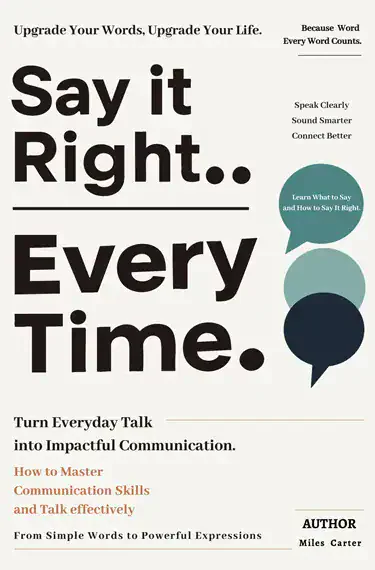
Book One: Say It Right..Every Time. by Miles Carter
This book was the one that finally made everything click. It’s not just about talking—it’s about understanding why communication breaks down and how to fix it. The book breaks communication into three core areas: expressing yourself clearly, building emotional connection, and staying calm under pressure. Each chapter gives you specific scripts, before-and-after examples, and real-world case studies.
What I loved is that it doesn’t just tell you what to say—it shows you. Every technique comes with a comparison: here’s the ineffective way people usually phrase it, and here’s the better way. For example, instead of “You’re not listening to me,” you learn to say “I feel like I’m not being heard right now.” Small shift. Massive difference. The chapter on the “Echo Technique” taught me to make people feel understood before responding—and that alone transformed how my conversations go.
This is the book I keep on my desk, not my shelf. Because when I have a difficult conversation coming up, I don’t need theory. I need words that work.
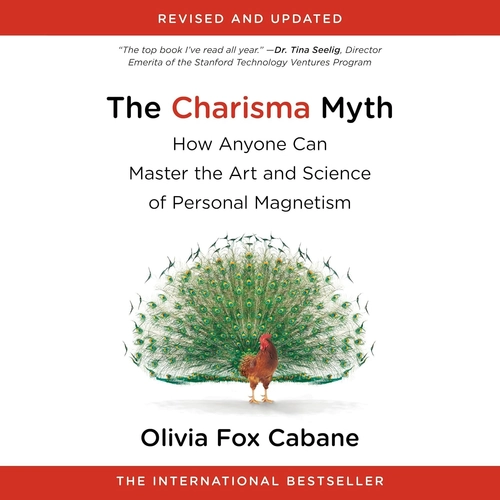
Book Two: The Charisma Myth by Olivia Fox Cabane
This book surprised me. I picked it up thinking it would be about being outgoing or funny—things I’m not. Instead, it’s about presence. Cabane argues that charisma isn’t innate. It’s a set of learnable behaviors: presence, power, and warmth. And the most important of those is presence—being fully here, not distracted or rehearsing what you’ll say next.
The book is filled with practical exercises. One that stuck with me: when you feel nervous before a conversation, imagine yourself surrounded by warmth, or picture the other person as someone you love. It sounds odd, but it changes your body language, your tone, and how people respond to you. Another technique: focusing on physical sensations in your body to anchor yourself in the moment instead of spiraling into anxiety.
What I loved is that it addresses the internal state first. You can’t fake charisma if your mind is racing. This book taught me to calm myself before I try to connect. That changed everything.
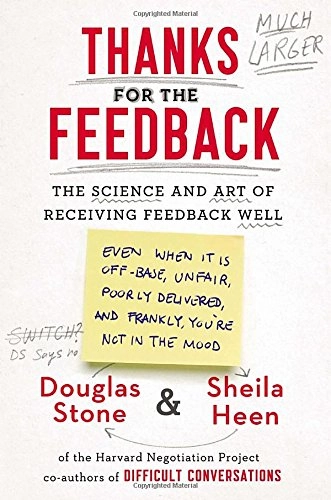
Book Three: Thanks for the Feedback by Douglas Stone and Sheila Heen
This one is about the other half of communication: listening. Specifically, listening when someone is telling you something you don’t want to hear. Stone and Heen, who also wrote Difficult Conversations, argue that receiving feedback is actually harder than giving it. We get defensive, we dismiss, we take it personally. And that shuts down communication before it can even start.
The book breaks feedback into three types: appreciation, coaching, and evaluation. Most conflict happens because we’re giving one type and receiving another. Your boss thinks she’s coaching you. You hear it as evaluation. Understanding that distinction saved me from countless misunderstandings.
The chapter on “identity triggers” was especially powerful. It explains why certain feedback hits us so hard—because it threatens how we see ourselves. Once I understood that, I could separate the message from my ego. I stopped treating feedback as an attack and started treating it as information.
The Thread That Connects Them
The first book taught me how to say things. The second taught me how to be present. The third taught me how to listen. Together, they cover the full circle of communication: expressing, connecting, and receiving.
But if you’re like me—someone who needs to see results fast, not after months of practice—start with Say It Right..Every Time. It’s the most practical, the most actionable, and the one you’ll actually use tomorrow. The other two books will make you wiser over time. This one will make you better by tonight. It costs less than lunch. The cost of staying misunderstood? That’s your relationships, your career, and your peace of mind.