The Loop I Couldn’t Escape
Last Friday, I left the workplace at 6 p.m., got home with a fried chicken order, and sank onto the couch. My body was off work—but my mind wasn’t.
It started with a tiny thought: Had I replied to a colleague’s message in an inappropriate tone? Then it spiraled. By 9 p.m., I had mentally replayed three conversations, drafted two alternative replies, and convinced myself that my coworker’s silence actually meant, “I’m upset with you.”
The worst part? This wasn’t a one-time thing. On Saturday morning, as I was making coffee, I suddenly caught myself frowning—still mulling over a conversation from Tuesday. My weekends felt hijacked: my body was resting, but my mind was still at the office.
I knew I needed something—not “just stop caring” advice, but something simple, doable, and actually effective for a brain that wouldn’t shut up.
The 3-Question Rule I Decided to Test
I stumbled on something called the 3-Question Filter—it comes from CBT. Super simple, surprisingly simple:
When your brain starts spinning about work, hit pause and go through these three questions. And yeah, do them in order:
Question 1: Is this happening right now?
Question 2: What would I tell a friend?
Question 3: What’s one tiny action?
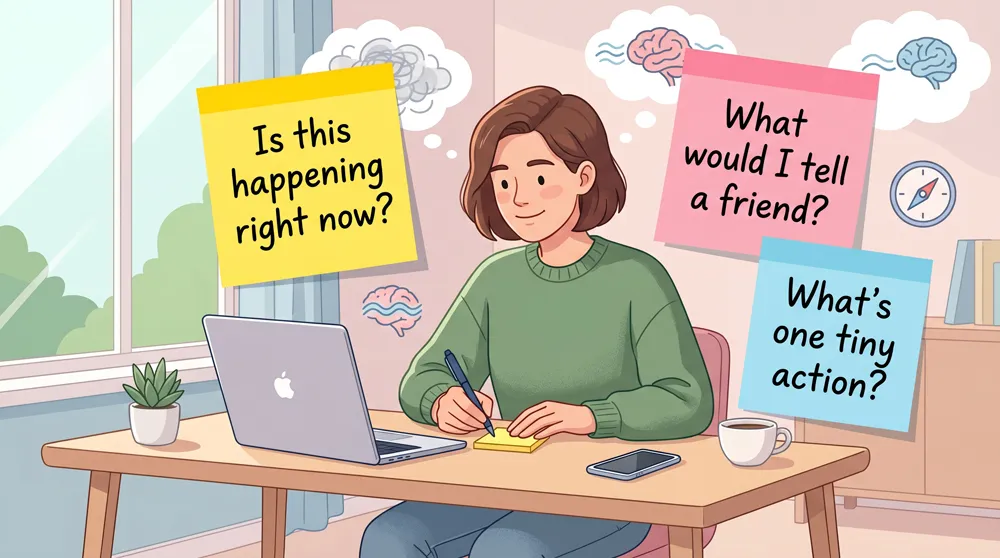
That’s it. No 20-page journaling. No analyzing your childhood needed. Just three questions. The author claimed that most people fail at this, not because the questions are hard, but because they try to answer them in their head—you have to write them down.
I decided to test this for one full week. Every time I caught myself replaying work in my head, I’d pull out a sticky note and answer these three questions by hand. If it didn’t help after 7 days, I would give it up.
What Actually Happened (The Messy, Real Version)
Day 1: The First Attempt Was a Struggle
Saturday morning, 9:30 a.m. I’m pouring cereal when suddenly I remember an email I sent on Thursday that had a slightly awkward tone. My brain immediately starts spinning: Did I sound passive-aggressive? What if they think I’m rude? Maybe I should send a follow-up to clarify—I caught myself and pulled out a sticky note.

Q1: Is this even happening right now?
I wrote: No. I’m holding a cereal box. The email is two days old. Nobody has replied angrily.
My brain argued: But they might be silently annoyed! I pushed through.
Q2: What would I tell a friend?
I wrote: You’re overthinking a tone that probably wasn’t even there. If they had an issue, they’d tell you. Don’t fix a problem that hasn’t happened.
This one hit me. I actually felt a small exhale.
Q3: What’s one tiny action?
I stared at this one. So what could I actually do about a Thursday email on a Saturday morning? Obvious answer: nothing. Just eat my cereal and move on. Anxiety didn’t disappear, but I also didn’t open my work email. That honestly felt like a tiny win.
Day 3: Almost Quit at Question 2
Sunday evening, I remembered the team meeting on Friday, when I had hesitated while explaining my work progress. The replay in my head was brutal: I sounded unprepared. They probably think I’m incompetent. This is going to affect our relationship forever.
I pulled out my sticky note, irritated. I was already tired of this exercise.

Q1: Is this happening right now?
No. It’s Sunday, 8 p.m. The meeting was on Friday. Nobody has said anything.
Q2: What would I tell a friend?
This is where I almost gave up. I knew exactly what I’d say to a friend: “One stumble in a 45-minute meeting? No one remembers that. You’re holding yourself to an impossible standard.”
Saying that to myself felt like letting myself off the hook, and noticing that resistance became the turning point. The reason I couldn’t stop replaying wasn’t because something was actually wrong—it was because I had a rule in my head that I wasn’t allowed to stumble. The filter made me see my own rule.
Q3: What’s one tiny action?
I wrote: If it still bothers me Monday morning, I can prepare one clarification point and send a quick follow-up. Not now.
I folded the sticky note, put it on my nightstand, and went to sleep. The urgency was gone.
Day 7: Not a Miracle Fix, But Something Shifted
By the end of the week, I hadn’t stopped overthinking entirely. That wouldn’t be realistic. But three things had changed:
- The episodes got shorter. Instead of spiraling for two hours, most replays lasted about 10 minutes once I pulled out the sticky note.
- I caught myself faster. By day five, I could recognize the “replay loop” within the first few spins, instead of being trapped in it for an hour before noticing.
- I discovered something the exercise doesn’t tell you. The real power isn’t in Question 3 (the action). It’s in Question 2—the moment you force yourself to give yourself the same compassion you’d give a friend. That’s the muscle that grows.

4. What I Learned (That I Haven’t Seen Anywhere Else)
Most advice about overthinking tells you to “think positive” or “just let it go.” That never worked for me because it’s too abstract. What actually helped was the physical act of writing the answers by hand.
When I just thought through the three questions in my head, my brain could still spin. The sticky note forced me to see how ridiculous my worries looked on paper—you can’t argue with your own handwriting.
Also, here’s a trap nobody mentions: Some days, you’ll answer the questions and still feel anxious. That doesn’t mean the method failed. It just means you’ve built years of overthinking habits, and one sticky note won’t undo it in a day. Think of it like going to the gym—you don’t expect a six-pack after one workout. My mind never knows how to clock out, even when my body is already off duty.
A Small Tool I Made for You
After that week, I turned the 3-Question Filter into a simple, one-page printable card. It includes the three questions, space to jot down your answers, and a single reminder sentence I wish someone had shared with me earlier.
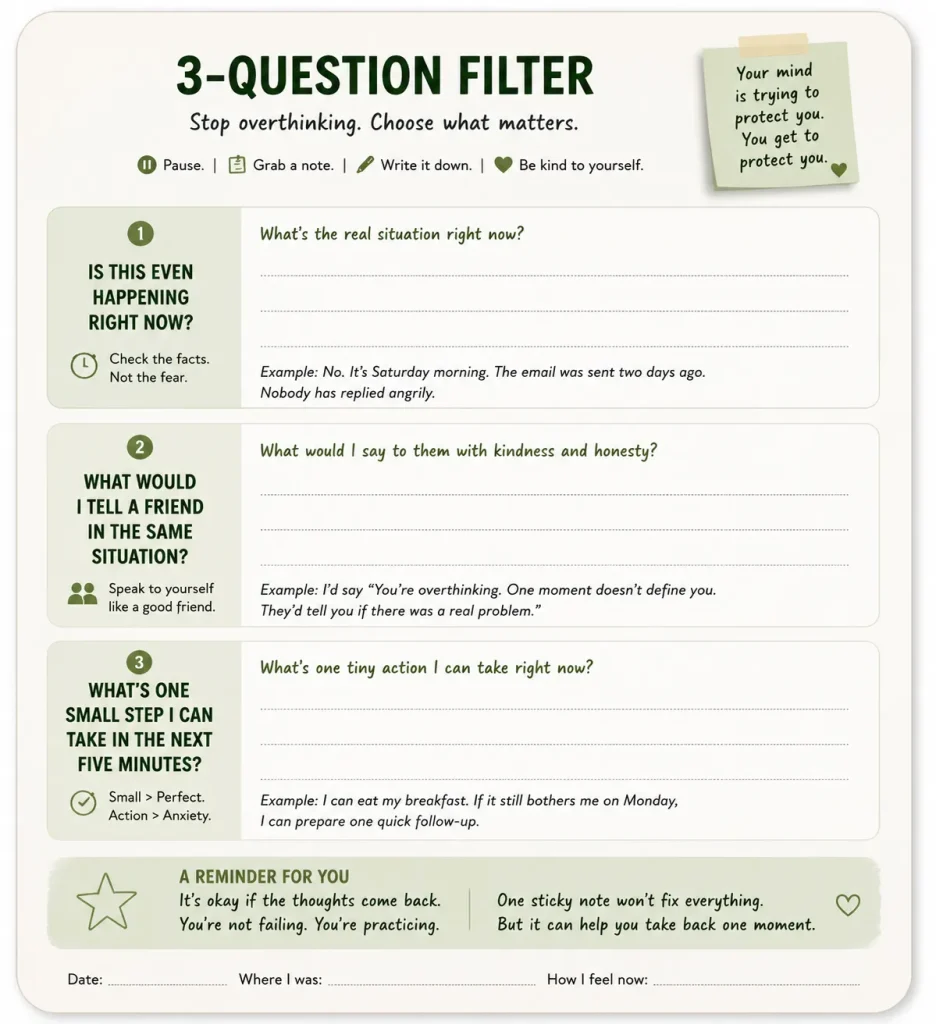
Keep it on your desk or tucked in your bag. Next time your brain won’t stop racing, you don’t even have to remember the questions—they’re right there.