You send a text. The typing bubble appears for one second, then disappears. Two hours later, you’re still thinking: “Did I say something wrong?”
That’s the dilemma for highly sensitive people (HSPs). In person, your empathy is a gift. But on a screen, silence makes your brain write its own stories. The three methods below won’t tell you to “just stop caring.” Instead, they interrupt the overthinking loop in different ways.

Path One: The Three-Explanation Rule
Why your brain reads too much: when information is missing, your brain fills the gap with the most threatening story. It’s an ancient survival mechanism, but that story is almost never true.
How to break it: next time you catch yourself spiraling, stop and write down three possible reasons for the silenc
- The first one will be your fear (they’re angry).
- The second should be neutral (their phone died).
- The third should be boring (they got distracted by a notification and forgot to reply).
What happens: your brain can’t hold three stories with the same emotional intensity at once. The neutral and boring options take power away from the threatening one. You don’t have to believe them; you just have to list them.
When this fails: if the person has a history of being mean or passive-aggressive, your brain’s scary story might be accurate. In that case, the problem isn’t your sensitivity; it’s the relationship itself. This rule is for safe people, not for someone who has actually hurt you before.

Path Two: The Two-Minute Delay You Schedule in Advance
A counterintuitive truth: trying not to check your phone only makes you want to check it more. That’s called ironic rebound. So don’t fight the urge; outsmart it.
How to set it up: every morning, pick two blocks of two minutes each, one at 11 a.m. and one at 3 p.m. During those blocks, you’re allowed to overanalyze as much as you want. Check the message, analyze it, imagine the worst, feel anxious. When the two minutes are up, you stop. You don’t delete the message or reply; you just close the app and go back to work.
Why this is different: it gives your obsessive brain a designated container instead of fighting it all day. After a few days, you’ll notice that by the time your 3 p.m. block arrives, you no longer care about the morning message. The anxiety has an expiration date that you set.
An honest limitation: this doesn’t work for urgent texts from your boss, your partner, or a doctor. Use it only for low-stakes messages where a reply won’t actually change your life.

Path Three: The “What Would a Safe Person Say?” Pivot
The real problem: overanalyzing isn’t about the message itself but about a lack of safety. Your nervous system is asking: “Am I still liked? Am I still safe in this relationship?” Silence sounds like “no.”
The pivot: don’t analyze the sender. Imagine you’re analyzing the message with your safest friend. Ask yourself: “If my best friend had sent me this exact text, would I be worried?” The answer is almost always no. You’d assume they were busy, tired, or typing with one hand while holding coffee.
Why this isn’t just imagination: your brain treats social threats and physical threats similarly. By borrowing the safety of a trusted friend, you lower your cortisol response. You’re not lying to yourself; you’re reminding your brain that the same words can look different depending on who sent them.
Where this breaks: if you don’t have a safe person in your life, this method is hard to use. (Building that relationship takes time, so this method isn’t for everyone.) Also, if the sender has a pattern of giving the silent treatment or being deliberately vague, don’t use this method. Trust your pattern recognition.
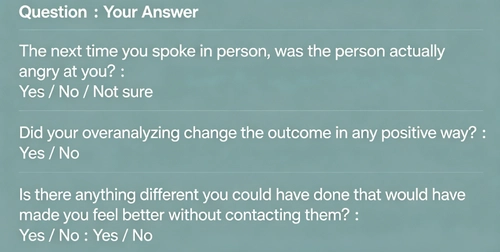
A Quick Self-Test for Your Last Overthinking Episode
Think back to the last text that made you spiral. Answer these three questions without overthinking.
If you answered No to the first question, you have evidence that your brain lies to you. Save that evidence. Next time you spiral, remind yourself: “Last time, I was wrong.”