You know that feeling when your brain decides to replay an awkward conversation from three years ago at 2 AM? Or when your chest tightens for no reason, and suddenly you’re preparing for ten different catastrophes that haven’t happened yet? I’ve been there more times than I care to admit. For the longest time, I thought I just needed to “push through” or “calm down”—which, as you probably know, never actually works.
What finally helped wasn’t vague advice about finding peace. It was concrete, practical tools I could use when my mind started spiraling. Over the past few years, I’ve read dozens of books on anxiety, and three of them genuinely changed how I relate to my own thoughts. Here they are—one from our collection, and two classics that have helped millions.
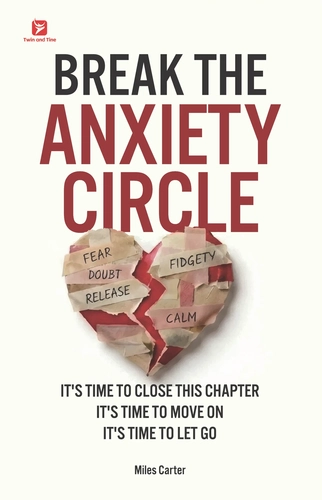
Book One: Break the Anxiety Circle by Miles Carter
This one hit differently because it doesn’t treat you like a broken machine in need of fixing. Instead, it feels like sitting down with someone who actually gets it—someone who knows that telling an anxious person to “just stop worrying” is about as useful as telling a drowning person to relax. The book opens with a section on self-love that completely reframed how I see my anxiety. It gently points out that much of our anxious spiraling comes from a deep belief that we’re not enough, constantly trying to prove our worth to people who aren’t even paying attention.
What I loved most are the chapters on reconciling with the past and taming the “emotional monster.” There’s a line that stuck:
“Action is the antidote to anxiety.”
It sounds simple, but the book walks you through exactly what that action looks like in practice—small, tangible steps that interrupt the loop before it pulls you under. It teaches you to recognize anxiety not as an enemy, but as a signal to investigate. That shift alone made everything feel more manageable. By the end, I had a mental toolkit I could actually reach for when my thoughts started spiraling.
Book Two: The Anxiety and Phobia Workbook by Edmund J. Bourne
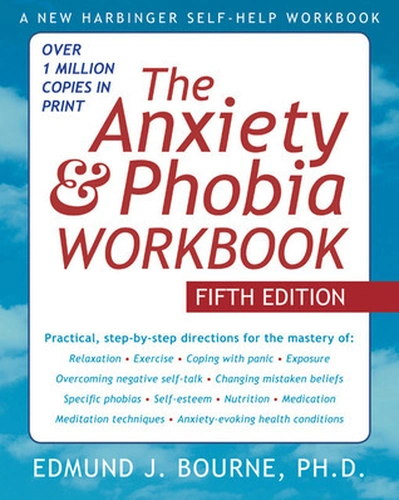
If Break the Anxiety Circle is the compassionate friend who holds your hand, this workbook is the no-nonsense coach who hands you a detailed plan and says, “Here’s exactly what to do next.” It’s been a bestseller for decades, updated multiple times, for good reason—it works. This is the book you turn to when you need specific, actionable techniques, not just emotional comfort.
The workbook breaks everything down into manageable pieces:
- Breathing techniques
- Progressive muscle relaxation
- Nutritional changes that affect stress levels
- Worksheets for challenging irrational thoughts
What I appreciated most is that it doesn’t assume one-size-fits-all. It acknowledges that everyone’s anxiety looks different and gives you tools to build a customized approach. Whether you struggle with panic attacks, social anxiety, or just that low-grade hum of dread that never turns off, there’s something in here for you.
Book Three: Feeling Good: The New Mood Therapy by David D. Burns
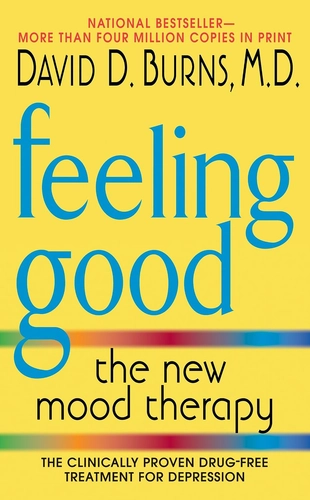
This one is a classic for a reason. It’s the book that popularized cognitive behavioral therapy (CBT) for the general public, and reading it felt like someone finally handed me the user manual to my own brain. Burns identifies ten specific “cognitive distortions”—patterns of thinking that are technically incorrect but feel completely true when you’re in the middle of them. Things like:
- All-or-nothing thinking
- Mental filtering
- Catastrophizing
The moment I read about catastrophizing, I felt genuinely seen. That thing where you assume the worst possible outcome and start preparing for it as if it’s already done? That’s been my entire adult life. Burns doesn’t just name the problem—he gives you a method to fight back. He teaches you to write down your anxious thoughts, identify the distortions, and craft more realistic, balanced responses. It sounds simple, but putting pen to paper actually changes something in your brain. It externalizes the spiral and lets you see how irrational it really is.
What I Learned From All Three
Together, these books taught me that breaking the anxiety loop isn’t about eliminating anxiety entirely—that’s probably never happening. It’s about changing my relationship with it. Recognizing the spiral when it starts and having a plan to respond, rather than getting swept away. The first gave me compassion, the second gave me techniques, the third gave me a framework.
If you’re stuck in that loop right now, I hope one of these finds its way to you. You don’t have to figure it out alone.