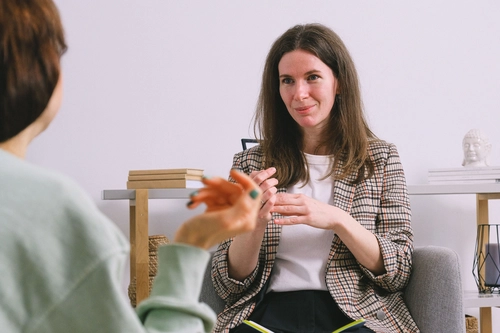
I still remember standing in line at a library, holding a book, asking the person behind the counter a simple question. Her face changed. Her tone went sharp. I felt my throat close up and my eyes sting, and I almost cried right there over a library book. That was the moment I realized I needed to figure out how to deal with social anxiety in public, because I could not keep living like every stranger was a small emergency.
Many people freeze when someone honks at them. Many replay a rude comment for three days. If that is you, you are not alone. Not even close.
Quick Calm-Down Actions You Can Use Today
- Breathe out longer than you breathe in. Try a four count in, six count out.
- Ask yourself one question: “Am I actually in danger right now?”
- Say one small sentence to one stranger. A “thank you” counts.
- Name the feeling quietly. “This is my nerves, not a fact.”
- Give the moment a time limit. “I only have to do this for 30 seconds.”
Why Does My Anxiety in Public Get Worse Around Strangers?
I have noticed a pattern in myself and in others who struggle with this. You are sensitive. You notice everything. A tone of voice. A sigh. The way someone looks at you for half a second too long.
That sensitivity is not a flaw. It is a dial that is turned up high.
Here is what I think happens. When you are alone in public, your brain treats every stranger as an unknown, and unknowns feel risky. A car honks, and your body reacts like it is a real threat. Someone snaps at you, and your whole nervous system floods.
You freeze. You go blank. You feel awkward.
And then the worst part hits. You replay it for hours. Days, sometimes. Even when you know it was not your fault.
One rude person can ruin your whole day because your brain files it under danger, not annoying. It is trying to protect you. It is just doing a terrible job of it.
The good news? That dial can be turned down. Slowly. With practice.
How to Stop Freezing Up Around Strangers
This is the part I wish someone had told me years ago. You do not stop freezing by forcing yourself to be bold. You stop by shrinking the moment until it is small enough to survive.
Try this. Next time you have to talk to a cashier, ask one question. Just one. “Do you know if this is on sale?” That is it. You do not need to be charming. You do not need to smile right. You just need one sentence.
Here is a script I have used:
Them: (rude tone)
You: “Thanks, I’ll take a look.” Then step away, breathe, and let it go.
You do not have to win the exchange. You just have to get through it without spiraling.
I call this having an exit plan. You go in knowing exactly how you will leave. That alone lowers the panic.

A Trick That Helped Me Borrow Confidence
There is a trick I picked up that sounds silly until you try it. You pretend you are doing the hard thing for someone else.
A shy friend. A younger sibling. A kid in your head who needs you to speak up. You imagine they are standing behind you, and you are protecting them.
Why does this work? Because your brain does not fire the same fear signal when you are helping someone else. You stop being the target. You become the shield.
I have used it in grocery stores, on phone calls, and once at a DMV counter. It works. And after a while, you need it less and less.
Small Steps, Not Big Leaps
A lot of advice online says “face your fears” or “get out of your comfort zone.” That is fine if your fear is a spider. It is terrible advice if your fear is people.
What helped me was staying in what some call the learning zone. Not the panic zone.
| Zone | What it feels like | What to do |
|---|---|---|
| Comfort | Safe, easy, alone | Use this to recharge |
| Learning | A little nervous, still in control | Stay here. This is where growth happens |
| Panic | Heart racing, want to flee | Step back. You went too fast |
One step at a time. A short walk outside. A hello to a neighbor. A question at a store. That is enough.
When Rudeness Is Not About You
Here is something that changed everything for me. That librarian who snapped at me? I found out later her shift had been brutal. A customer before me had yelled at her for ten minutes.
Her rudeness was not about me. It never was.
Most people who snap, honk, or glare are carrying something you cannot see. A sick parent. A fight with a partner. A deadline they are failing at. You are just the person standing nearby when it spills over.
That does not excuse it. But it does mean you do not have to carry it.
FAQ
Q: How do I deal with social anxiety in public when I have to go somewhere alone?
A: Start with short trips. Five minutes. A walk to the mailbox. Build up slowly. The goal is not to feel calm. It is to prove to yourself you can survive the nerves.
Q: What do I say when a stranger is rude to me?
A: You do not owe them a response. “Okay, thanks” and walking away is a complete sentence. You are allowed to leave.
Q: Does social anxiety in public ever go away completely?
A: For most people, it fades instead of disappearing. You get better at handling it. The nerves get quieter. That is a win.
Q: Can I deal with social anxiety in public without therapy or medication?
A: Some people do, with slow practice and support. Others find that talking to a doctor helps a lot. Both paths are valid.
Q: What if I try these steps and still freeze up?
A: That happens. Some days are harder than others. Be kind to yourself. Every time you try, you are building a new habit. It takes time.
One Last Thing
That library moment still lives in my head. But it is smaller now. It is not the story of who I am. It is just a Tuesday that went badly.
You are not broken. You are sensitive. And sensitive people can still walk into the world, one small step at a time.
References
- American Psychological Association. (n.d.). Anxiety. Retrieved from apa.org.
- Anxiety and Depression Association of America. (n.d.). Social anxiety disorder. Retrieved from adaa.org.
- Bourne, E. J. (2011). The Anxiety and Phobia Workbook. New Harbinger Publications.